


Page 602 - ISC PROCEEDINGS 21.4
P. 602
support collaborative learning. Interactive dialogue systems and conversational agents
                   are some of the features that can be found in some AI-based language learning systems
                   and that can simulate a real-life communication environment. Such systems enable
                   learners to rehearse conversational skills within a conducive and non-threatening space.
                        3. Conceptual framework
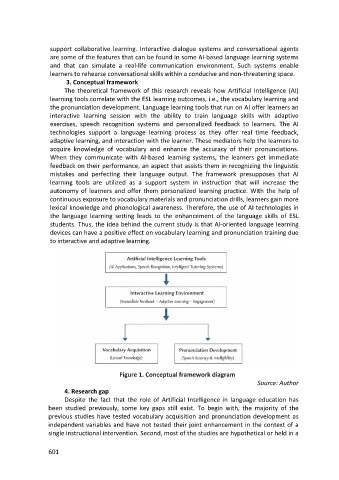
                        The theoretical framework of this research reveals how Artificial Intelligence (AI)
                   learning tools correlate with the ESL learning outcomes, i.e., the vocabulary learning and
                   the pronunciation development. Language learning tools that run on AI offer learners an
                   interactive learning session with the ability to train language skills with adaptive
                   exercises, speech recognition systems and personalized feedback to learners. The AI
                   technologies support a language learning process as they offer real time feedback,
                   adaptive learning, and interaction with the learner. These mediators help the learners to
                   acquire knowledge of vocabulary and enhance the accuracy of their pronunciations.
                   When they communicate with AI-based learning systems, the learners get immediate
                   feedback on their performance, an aspect that assists them in recognizing the linguistic
                   mistakes and perfecting their language output. The framework presupposes that AI
                   learning tools are utilized as a support system in instruction that will increase the
                   autonomy of learners and offer them personalized learning practice. With the help of
                   continuous exposure to vocabulary materials and pronunciation drills, learners gain more
                   lexical knowledge and phonological awareness. Therefore, the use of AI technologies in
                   the language learning setting leads to the enhancement of the language skills of ESL
                   students. Thus, the idea behind the current study is that AI-oriented language learning
                   devices can have a positive effect on vocabulary learning and pronunciation training due
                   to interactive and adaptive learning.


                                           Figure 1. Conceptual framework diagram
                                                                                           Source: Author
                        4. Research gap
                        Despite the fact that the role of Artificial Intelligence in language education has
                  been studied previously, some key gaps still exist. To begin with, the majority of the
                  previous studies have tested vocabulary acquisition and pronunciation development as
                  independent variables and have not tested their joint enhancement in the context of a
                  single instructional intervention. Second, most of the studies are hypothetical or held in a


                  601

