


Page 605 - ISC PROCEEDINGS 21.4
P. 605
exercises. This personalized learning experience enabled them to learn at a pace they
                  preferred and be offered the specific support needed hence they achieved positive
                  vocabulary acquisition outcomes. Also, AI learning tools enhanced the level of
                  engagement and motivation among learners. It was also reported that creativity of AI-
                  based activities helped many of the participants to enjoy vocabulary learning, unlike
                  classroom exercises. The results are in line with the existing research pointing to the
                  efficiency of AI-based learning systems in enhancing the engagement of learners and
                  boosting their vocabulary acquisition (Godwin-Jones, 2019).
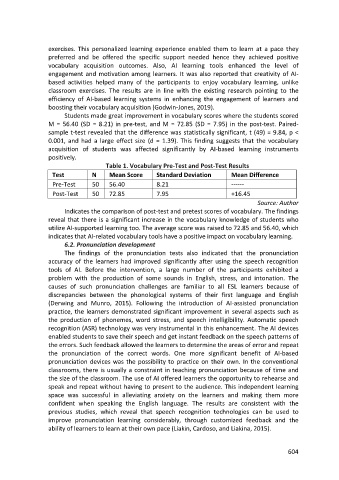
                        Students made great improvement in vocabulary scores where the students scored
                  M = 56.40 (SD = 8.21) in pre-test, and M = 72.85 (SD = 7.95) in the post-test. Paired-
                  sample t-test revealed that the difference was statistically significant, t (49) = 9.84, p <
                  0.001, and had a large effect size (d = 1.39). This finding suggests that the vocabulary
                  acquisition of students was affected significantly by AI-based learning instruments
                  positively.
                                      Table 1. Vocabulary Pre-Test and Post-Test Results
                   Test          N     Mean Score       Standard Deviation        Mean Difference
                   Pre-Test      50    56.40            8.21                      ------
                   Post-Test     50    72.85            7.95                      +16.45
                                                                                           Source: Author
                        Indicates the comparison of post-test and pretest scores of vocabulary. The findings
                  reveal that there is a significant increase in the vocabulary knowledge of students who
                  utilize AI-supported learning too. The average score was raised to 72.85 and 56.40, which
                  indicates that AI-related vocabulary tools have a positive impact on vocabulary learning.
                        6.2. Pronunciation development
                        The findings of the pronunciation tests also indicated that the pronunciation
                  accuracy of the learners had improved significantly after using the speech recognition
                  tools of AI. Before the intervention, a large number of the participants exhibited a
                  problem with the production of some sounds in English, stress, and intonation. The
                  causes of such pronunciation challenges are familiar to all ESL learners because of
                  discrepancies between the phonological systems of their first language and English
                  (Derwing and Munro, 2015). Following the introduction of AI-assisted pronunciation
                  practice, the learners demonstrated significant improvement in several aspects such as
                  the production of phonemes, word stress, and speech intelligibility. Automatic speech
                  recognition (ASR) technology was very instrumental in this enhancement. The AI devices
                  enabled students to save their speech and get instant feedback on the speech patterns of
                  the errors. Such feedback allowed the learners to determine the areas of error and repeat
                  the pronunciation of the correct words. One more significant benefit of AI-based
                  pronunciation devices was the possibility to practice on their own. In the conventional
                  classrooms, there is usually a constraint in teaching pronunciation because of time and
                  the size of the classroom. The use of AI offered learners the opportunity to rehearse and
                  speak and repeat without having to present to the audience. This independent learning
                  space was successful in alleviating anxiety on the learners and making them more
                  confident when speaking the English language. The results are consistent with the
                  previous studies, which reveal that speech recognition technologies can be used to
                  improve pronunciation learning considerably, through customized feedback and the
                  ability of learners to learn at their own pace (Liakin, Cardoso, and Liakina, 2015).


                                                                                                      604

