


Page 520 - ISC PROCEEDINGS 21.4
P. 520
Dependent variable: LN1ZSCORE


                                      (0.0596)                           (0.0592)
                 GDPG                 0.0125                             0.0040

                                      (0.0115)                           (0.0118)

                 INFLATION            0.0319***                          0.0236***
                                      (0.0090)                           (0.0091)

                 Constant             1.3317***                          1.9460***

                                      (0.2527)                           (0.2505)


                 Wald chi2            257.40                             179.47

                 Prob > chi2          0.0000                             0.0000
                 Number of groups 143                                    143

                 Observations         562                                562
                    Note: ***, **, and * indicate the significance at the 1%, 5%, and 10% level, respectively.
                                              Source: Authors’ compilation from analysis data with Stata 17
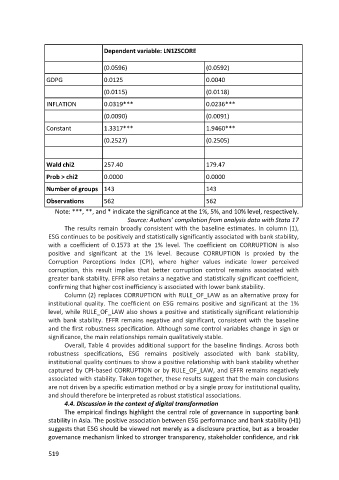
                        The results remain broadly consistent with the baseline estimates. In column (1),
                  ESG continues to be positively and statistically significantly associated with bank stability,
                  with a coefficient of 0.1573 at the 1% level. The coefficient on CORRUPTION is also
                  positive and significant at the 1% level. Because CORRUPTION is proxied by the
                  Corruption Perceptions Index (CPI), where higher values indicate lower perceived
                  corruption, this result implies that better corruption control remains associated with
                  greater bank stability. EFFR also retains a negative and statistically significant coefficient,
                  confirming that higher cost inefficiency is associated with lower bank stability.
                        Column (2) replaces CORRUPTION with RULE_OF_LAW as an alternative proxy for
                  institutional quality. The coefficient on ESG remains positive and significant at the 1%
                  level, while RULE_OF_LAW also shows a positive and statistically significant relationship
                  with bank stability. EFFR remains negative and significant, consistent with the baseline
                  and the first robustness specification. Although some control variables change in sign or
                  significance, the main relationships remain qualitatively stable.
                        Overall, Table 4 provides additional support for the baseline findings. Across both
                  robustness specifications, ESG remains positively associated with bank stability,
                  institutional quality continues to show a positive relationship with bank stability whether
                  captured by CPI-based CORRUPTION or by RULE_OF_LAW, and EFFR remains negatively
                  associated with stability. Taken together, these results suggest that the main conclusions
                  are not driven by a specific estimation method or by a single proxy for institutional quality,
                  and should therefore be interpreted as robust statistical associations.
                        4.4. Discussion in the context of digital transformation
                        The empirical findings highlight the central role of governance in supporting bank
                  stability in Asia. The positive association between ESG performance and bank stability (H1)
                  suggests that ESG should be viewed not merely as a disclosure practice, but as a broader
                  governance mechanism linked to stronger transparency, stakeholder confidence, and risk

                  519

