


Page 519 - ISC PROCEEDINGS 21.4
P. 519
Note: ***, **, and * indicate the significance at the 1%, 5%, and 10% level,
                  respectively.
                                              Source: Authors’ compilation from analysis data with Stata 17
                        The table above presents the Fixed Effects regression results with clustered
                  standard errors for bank stability (LN1ZSCORE). ESG is positively and significantly
                  associated with bank stability (β = 0.2034, p < 0.01), supporting H1. CORRUPTION also
                  shows a positive and significant coefficient (β = 0.0312, p < 0.01), consistent with H2. By
                  contrast, LN_TA, EA, and GDPG are not statistically significant. EFFR is negatively
                  associated with bank stability at the 1% level, while inflation is positive and significant at
                  the same level. These results should be interpreted as statistical associations rather than
                  causal effects.
                        The within R-squared of 0.2722 indicates that the explanatory variables account for
                  a meaningful share of within-bank variation in bank stability over time. The rho value of
                  0.6371 suggests that a substantial proportion of the total variance is attributable to
                  unobserved bank-specific effects. Clustering standard errors at the bank level further
                  improves inference by accounting for heteroskedasticity and within-bank serial
                  correlation.
                        4.3. Robustness checks
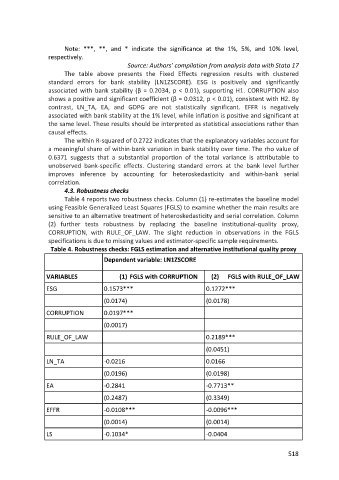
                        Table 4 reports two robustness checks. Column (1) re-estimates the baseline model
                  using Feasible Generalized Least Squares (FGLS) to examine whether the main results are
                  sensitive to an alternative treatment of heteroskedasticity and serial correlation. Column
                  (2) further tests robustness by replacing the baseline institutional-quality proxy,
                  CORRUPTION, with RULE_OF_LAW. The slight reduction in observations in the FGLS
                  specifications is due to missing values and estimator-specific sample requirements.
                   Table 4. Robustness checks: FGLS estimation and alternative institutional quality proxy
                                      Dependent variable: LN1ZSCORE


                 VARIABLES                 (1) FGLS with CORRUPTION        (2)   FGLS with RULE_OF_LAW
                 ESG                  0.1573***                          0.1272***

                                      (0.0174)                           (0.0178)

                 CORRUPTION           0.0197***
                                      (0.0017)

                 RULE_OF_LAW                                             0.2189***

                                                                         (0.0451)
                 LN_TA                -0.0216                            0.0166

                                      (0.0196)                           (0.0198)

                 EA                   -0.2841                            -0.7713**
                                      (0.2487)                           (0.3349)

                 EFFR                 -0.0108***                         -0.0096***
                                      (0.0014)                           (0.0014)

                 LS                   -0.1034*                           -0.0404


                                                                                                      518

