


Page 495 - ISC PROCEEDINGS 21.4
P. 495
recommend shopping deals tailored precisely to cardholders' spending patterns.
                  Meanwhile, Nam A Bank has deployed service robots (the OPBA Robot) at physical
                  branches to greet and guide customers through administrative procedures, thereby
                  reducing the workload for front-desk staff.
                        Automated Credit Scoring and Loan Approval: AI technology is being leveraged to
                  bolster the consumer lending segment. Institutions such as VPBank and Techcombank
                  employ Machine Learning models to analyze transaction histories, utility bills, and even
                  telecommunications data for credit scoring. Consequently, customers can receive instant
                  approval for loans or credit card limits directly via mobile applications without the need
                  for physical salary statements. These automated AI systems evaluate default probabilities
                  to facilitate data-driven lending decisions.
                        Risk Management and Fraud Prevention: Major commercial banks, including BIDV,
                  Vietcombank, and Agribank, have invested heavily in 'intelligent monitoring' systems.
                  Upon detecting compromised cards or anomalous behavior—such as an ATM card
                  typically used in Hanoi suddenly initiating a withdrawal in another country—the AI-driven
                  system instantly suspends the card and issues a security alert. Furthermore, if a recipient
                  account is flagged on a blacklist or exhibits suspicious activity like immediate fund cycling
                  (a hallmark of 'mule accounts'), the system provides real-time warnings to the sender.
                        Mobile App Experience Personalization: AI functions as a private financial advisor, a
                  domain where TPBank has demonstrated significant proficiency. With its App 5.0, TPBank
                  utilizes AI to 'tailor' the user interface based on individual behavioral patterns. For
                  instance, if a user frequently initiates fund transfers, that specific function is prioritized on
                  the home screen. Conversely, for users inclined toward savings, high-yield interest
                  packages are surfaced. Similarly, Military Bank (MB) has implemented an AI-powered
                  'Financial Management' feature that analyzes monthly cash flows, issues alerts regarding
                  overspending in specific categories (such as dining or shopping), and recommends
                  optimal savings targets."
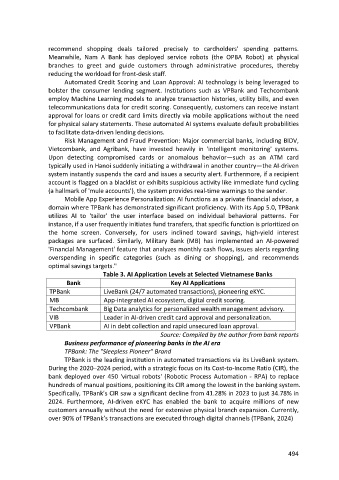
                                     Table 3. AI Application Levels at Selected Vietnamese Banks
                        Bank                                 Key AI Applications
                  TPBank             LiveBank (24/7 automated transactions), pioneering eKYC.
                  MB                 App-integrated AI ecosystem, digital credit scoring.
                  Techcombank        Big Data analytics for personalized wealth management advisory.
                  VIB                Leader in AI-driven credit card approval and personalization.
                  VPBank             AI in debt collection and rapid unsecured loan approval.
                                                         Source: Compiled by the author from bank reports
                        Business performance of pioneering banks in the AI era
                        TPBank: The "Sleepless Pioneer" Brand
                        TPBank is the leading institution in automated transactions via its LiveBank system.
                  During the 2020–2024 period, with a strategic focus on its Cost-to-Income Ratio (CIR), the
                  bank deployed over 450 'virtual robots' (Robotic Process Automation - RPA) to replace
                  hundreds of manual positions, positioning its CIR among the lowest in the banking system.
                  Specifically, TPBank’s CIR saw a significant decline from 41.28% in 2023 to just 34.78% in
                  2024. Furthermore, AI-driven eKYC has enabled the bank to acquire millions of new
                  customers annually without the need for extensive physical branch expansion. Currently,
                  over 90% of TPBank’s transactions are executed through digital channels (TPBank, 2024)


                                                                                                      494

