


Page 498 - ISC PROCEEDINGS 21.4
P. 498
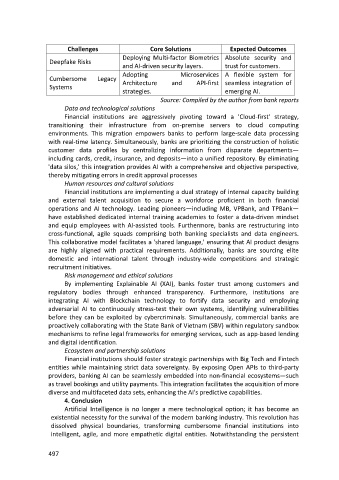
Challenges                   Core Solutions              Expected Outcomes
                                            Deploying Multi-factor Biometrics Absolute security and
                  Deepfake Risks
                                            and AI-driven security layers.      trust for customers.
                                            Adopting            Microservices A flexible system for
                  Cumbersome       Legacy   Architecture     and      API-first seamless integration of
                  Systems
                                            strategies.                         emerging AI.
                                                         Source: Compiled by the author from bank reports
                        Data and technological solutions
                        Financial institutions are aggressively pivoting toward a 'Cloud-first' strategy,
                  transitioning their infrastructure from on-premise servers to cloud computing
                  environments. This migration empowers banks to perform large-scale data processing
                  with real-time latency. Simultaneously, banks are prioritizing the construction of holistic
                  customer data profiles by centralizing information from disparate departments—
                  including cards, credit, insurance, and deposits—into a unified repository. By eliminating
                  'data silos,' this integration provides AI with a comprehensive and objective perspective,
                  thereby mitigating errors in credit approval processes
                        Human resources and cultural solutions
                        Financial institutions are implementing a dual strategy of internal capacity building
                  and external talent acquisition to secure a workforce proficient in both financial
                  operations and AI technology. Leading pioneers—including MB, VPBank, and TPBank—
                  have established dedicated internal training academies to foster a data-driven mindset
                  and equip employees with AI-assisted tools. Furthermore, banks are restructuring into
                  cross-functional, agile squads comprising both banking specialists and data engineers.
                  This collaborative model facilitates a 'shared language,' ensuring that AI product designs
                  are highly aligned with practical requirements. Additionally, banks are sourcing elite
                  domestic and international talent through industry-wide competitions and strategic
                  recruitment initiatives.
                        Risk management and ethical solutions
                        By implementing Explainable AI (XAI), banks foster trust among customers and
                  regulatory bodies through enhanced transparency. Furthermore, institutions are
                  integrating AI with Blockchain technology to fortify data security and employing
                  adversarial AI to continuously stress-test their own systems, identifying vulnerabilities
                  before they can be exploited by cybercriminals. Simultaneously, commercial banks are
                  proactively collaborating with the State Bank of Vietnam (SBV) within regulatory sandbox
                  mechanisms to refine legal frameworks for emerging services, such as app-based lending
                  and digital identification.
                        Ecosystem and partnership solutions
                        Financial institutions should foster strategic partnerships with Big Tech and Fintech
                  entities while maintaining strict data sovereignty. By exposing Open APIs to third-party
                  providers, banking AI can be seamlessly embedded into non-financial ecosystems—such
                  as travel bookings and utility payments. This integration facilitates the acquisition of more
                  diverse and multifaceted data sets, enhancing the AI's predictive capabilities.
                        4. Conclusion
                        Artificial Intelligence is no longer a mere technological option; it has become an
                   existential necessity for the survival of the modern banking industry. This revolution has
                   dissolved physical boundaries, transforming cumbersome financial institutions into
                   intelligent, agile, and more empathetic digital entities. Notwithstanding the persistent


                  497

