


Page 493 - ISC PROCEEDINGS 21.4
P. 493
Transitioning to AI is not merely about installing software; it is a fundamental
                  transformation of the entire operational machinery onto a new technological foundation.
                  Legacy System Constraints: Traditional core banking systems often lack the flexibility
                  required to integrate with AI applications, which demand massive real-time data
                  processing capabilities. Specialist Shortages: There is a significant market deficit of
                  professionals who possess deep expertise in both finance and data science. Meanwhile,
                  traditional staff face the mounting pressure of displacement unless they undergo
                  comprehensive retraining.
                        Concentration and legal risks
                        Dependence on Third-Party AI Providers: Most banks currently lease AI
                  infrastructure from tech giants (Google, Microsoft, Amazon). If these partners experience
                  technical failures or outages, the global financial system could face simultaneous paralysis.
                        Incomplete Legal Frameworks: In Vietnam and many other nations, specific
                  regulations regarding legal liability when AI causes errors (e.g., resulting in the loss of
                  customer funds) are still under development. This creates a "gray zone" of risk for
                  banking institutions.
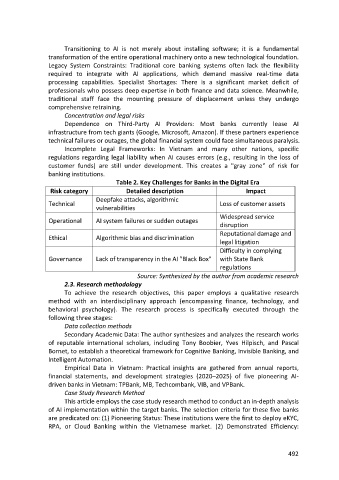
                                          Table 2. Key Challenges for Banks in the Digital Era
                   Risk category             Detailed description                      Impact
                                   Deepfake attacks, algorithmic
                  Technical                                                   Loss of customer assets
                                   vulnerabilities
                                                                              Widespread service
                  Operational      AI system failures or sudden outages
                                                                              disruption
                                                                              Reputational damage and
                  Ethical          Algorithmic bias and discrimination
                                                                              legal litigation
                                                                              Difficulty in complying
                  Governance       Lack of transparency in the AI "Black Box"  with State Bank
                                                                              regulations
                                                 Source: Synthesized by the author from academic research
                        2.3. Research methodology
                        To achieve the research objectives, this paper employs a qualitative research
                  method with an interdisciplinary approach (encompassing finance, technology, and
                  behavioral psychology). The research process is specifically executed through the
                  following three stages:
                        Data collection methods
                        Secondary Academic Data: The author synthesizes and analyzes the research works
                  of reputable international scholars, including Tony Boobier, Yves Hilpisch, and Pascal
                  Bornet, to establish a theoretical framework for Cognitive Banking, Invisible Banking, and
                  Intelligent Automation.
                        Empirical Data in Vietnam: Practical insights are gathered from annual reports,
                  financial statements, and development strategies (2020–2025) of five pioneering AI-
                  driven banks in Vietnam: TPBank, MB, Techcombank, VIB, and VPBank.
                        Case Study Research Method
                        This article employs the case study research method to conduct an in-depth analysis
                  of AI implementation within the target banks. The selection criteria for these five banks
                  are predicated on: (1) Pioneering Status: These institutions were the first to deploy eKYC,
                  RPA, or Cloud Banking within the Vietnamese market. (2) Demonstrated Efficiency:


                                                                                                      492

