


Page 428 - ISC PROCEEDINGS 21.4
P. 428
associated with their level of trust in that technology. In other words, expectancy
                  factors exert a positive influence on trust in AI. Based on this rationale, the following
                  hypotheses are proposed:
                        H6: Performance expectancy has a positive effect on residents’ trust in AI.
                        H7: Effort expectancy has a positive effect on residents’ trust in AI.
                        2.3.6. Trust in AI towards switching intentions
                        In the context of technology adoption in healthcare, trust in AI is defined as the
                  degree to which patients or healthcare professionals have confidence in the capability,
                  reliability, and benevolence of AI systems in supporting medical diagnosis and treatment
                  (Sagona et al., 2025). This construct is considered a key determinant influencing switching
                  intention (Ajzen, 1991). Empirical evidence across various domains indicates that trust has
                  a direct effect on switching intention (Li et al., 2007). Moreover, within the healthcare
                  sector, trust in AI has been shown to significantly influence the adoption of e-health
                  services; as users develop greater trust in AI-enabled healthcare services, they are more
                  likely to increase their intention to switch from traditional healthcare to AI-assisted
                  healthcare solutions (Gadabu et al., 2019). Based on this theoretical foundation, the
                  following hypothesis is proposed:
                        H8: Trust in AI has a positive effect on the switching intention to AI-assisted
                  healthcare
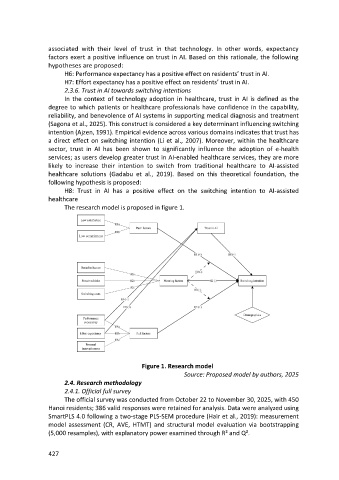
                        The research model is proposed in figure 1.


                                                   Figure 1. Research model
                                                                  Source: Proposed model by authors, 2025
                        2.4. Research methodology
                        2.4.1. Official full survey
                        The official survey was conducted from October 22 to November 30, 2025, with 450
                  Hanoi residents; 386 valid responses were retained for analysis. Data were analyzed using
                  SmartPLS 4.0 following a two-stage PLS-SEM procedure (Hair et al., 2019): measurement
                  model assessment (CR, AVE, HTMT) and structural model evaluation via bootstrapping
                  (5,000 resamples), with explanatory power examined through R² and Q².


                  427

