


Page 420 - ISC PROCEEDINGS 21.4
P. 420
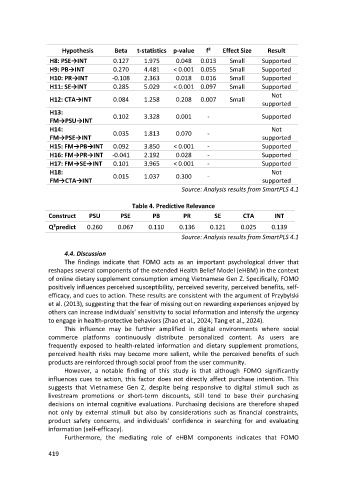
Hypothesis        Beta    t-statistics p-value    f²    Effect Size     Result
                   H8: PSE→INT           0.127      1.975      0.048   0.013      Small      Supported
                   H9: PB→INT            0.270      4.481     < 0.001 0.055       Small      Supported
                   H10: PR→INT          -0.108      2.363      0.018   0.016      Small      Supported
                   H11: SE→INT           0.285      5.029     < 0.001 0.097       Small      Supported
                                                                                                Not
                   H12: CTA→INT          0.084      1.258      0.208   0.007      Small
                                                                                             supported
                   H13:
                   FM→PSU→INT            0.102      3.328      0.001      -                  Supported
                   H14:                                                                         Not
                   FM→PSE→INT            0.035      1.813      0.070      -                  supported
                   H15: FM→PB→INT        0.092      3.850     < 0.001     -                  Supported
                   H16: FM→PR→INT       -0.041      2.192      0.028      -                  Supported
                   H17: FM→SE→INT        0.101      3.965     < 0.001     -                  Supported
                   H18:                                                                         Not
                   FM→CTA→INT            0.015      1.037      0.300      -                  supported
                                                                 Source: Analysis results from SmartPLS 4.1


                                               Table 4. Predictive Relevance
                  Construct     PSU        PSE         PB        PR         SE        CTA        INT

                  Q²predict     0.260     0.067      0.110      0.136      0.121      0.025     0.139
                                                                 Source: Analysis results from SmartPLS 4.1

                        4.4. Discussion
                        The findings indicate that FOMO acts as an important psychological driver that
                  reshapes several components of the extended Health Belief Model (eHBM) in the context
                  of online dietary supplement consumption among Vietnamese Gen Z. Specifically, FOMO
                  positively influences perceived susceptibility, perceived severity, perceived benefits, self-
                  efficacy, and cues to action. These results are consistent with the argument of Przybylski
                  et al. (2013), suggesting that the fear of missing out on rewarding experiences enjoyed by
                  others can increase individuals’ sensitivity to social information and intensify the urgency
                  to engage in health-protective behaviors (Zhao et al., 2024; Tang et al., 2024).
                        This influence may be further amplified in digital environments where social
                  commerce platforms continuously distribute personalized content. As users are
                  frequently exposed to health-related information and dietary supplement promotions,
                  perceived health risks may become more salient, while the perceived benefits of such
                  products are reinforced through social proof from the user community.
                        However, a notable finding of this study is that although FOMO significantly
                  influences cues to action, this factor does not directly affect purchase intention. This
                  suggests that Vietnamese Gen Z, despite being responsive to digital stimuli such as
                  livestream promotions or short-term discounts, still tend to base their purchasing
                  decisions on internal cognitive evaluations. Purchasing decisions are therefore shaped
                  not only by external stimuli but also by considerations such as financial constraints,
                  product safety concerns, and individuals’ confidence in searching for and evaluating
                  information (self-efficacy).
                        Furthermore, the mediating role of eHBM components indicates that FOMO

                  419

