


Page 416 - ISC PROCEEDINGS 21.4
P. 416
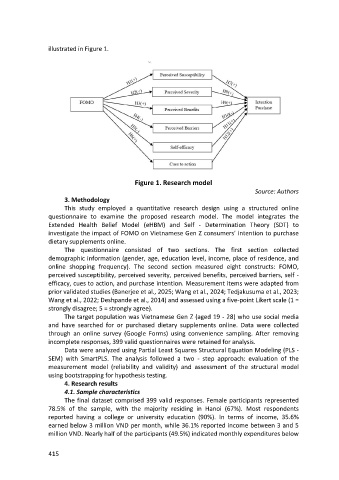
illustrated in Figure 1.


                                                Figure 1. Research model
                                                                                           Source: Authors
                        3. Methodology
                        This study employed a quantitative research design using a structured online
                  questionnaire to examine the proposed research model. The model integrates the
                  Extended Health Belief Model (eHBM) and Self - Determination Theory (SDT) to
                  investigate the impact of FOMO on Vietnamese Gen Z consumers’ intention to purchase
                  dietary supplements online.
                        The questionnaire consisted of two sections. The first section collected
                  demographic information (gender, age, education level, income, place of residence, and
                  online shopping frequency). The second section measured eight constructs: FOMO,
                  perceived susceptibility, perceived severity, perceived benefits, perceived barriers, self -
                  efficacy, cues to action, and purchase intention. Measurement items were adapted from
                  prior validated studies (Banerjee et al., 2025; Wang et al., 2024; Tedjakusuma et al., 2023;
                  Wang et al., 2022; Deshpande et al., 2014) and assessed using a five-point Likert scale (1 =
                  strongly disagree; 5 = strongly agree).
                        The target population was Vietnamese Gen Z (aged 19 - 28) who use social media
                  and have searched for or purchased dietary supplements online. Data were collected
                  through an online survey (Google Forms) using convenience sampling. After removing
                  incomplete responses, 399 valid questionnaires were retained for analysis.
                        Data were analyzed using Partial Least Squares Structural Equation Modeling (PLS -
                  SEM) with SmartPLS. The analysis followed a two - step approach: evaluation of the
                  measurement model (reliability and validity) and assessment of the structural model
                  using bootstrapping for hypothesis testing.
                        4. Research results
                        4.1. Sample characteristics
                        The final dataset comprised 399 valid responses. Female participants represented
                  78.5% of the sample, with the majority residing in Hanoi (67%). Most respondents
                  reported having a college or university education (90%). In terms of income, 35.6%
                  earned below 3 million VND per month, while 36.1% reported income between 3 and 5
                  million VND. Nearly half of the participants (49.5%) indicated monthly expenditures below


                  415

