


Page 188 - ISC PROCEEDINGS 21.4
P. 188
World Bank, 2022).. These indicators reflect both the technological infrastructure and the
                  institutional capacity required for digital financial service delivery.
                        In the context of Vietnam, the expansion of digital financial services has been
                  closely associated with improvements in digital connectivity and the rapid development
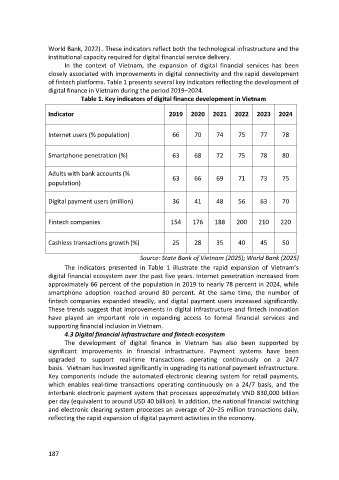
                  of fintech platforms. Table 1 presents several key indicators reflecting the development of
                  digital finance in Vietnam during the period 2019–2024.
                             Table 1. Key indicators of digital finance development in Vietnam

                  Indicator                                 2019    2020    2021   2022    2023    2024


                  Internet users (% population)               66     70      74      75     77      78


                  Smartphone penetration (%)                  63     68      72      75     78      80


                  Adults with bank accounts (%                63     66      69      71     73      75
                  population)


                  Digital payment users (million)             36     41      48      56     63      70


                  Fintech companies                          154     176    188     200     210     220


                  Cashless transactions growth (%)            25     28      35      40     45      50


                                                  Source: State Bank of Vietnam (2025); World Bank (2025)
                        The indicators presented in Table 1 illustrate the rapid expansion of Vietnam’s
                  digital financial ecosystem over the past five years. Internet penetration increased from
                  approximately 66 percent of the population in 2019 to nearly 78 percent in 2024, while
                  smartphone adoption reached around 80 percent. At the same time, the number of
                  fintech companies expanded steadily, and digital payment users increased significantly.
                  These trends suggest that improvements in digital infrastructure and fintech innovation
                  have played an important role in expanding access to formal financial services and
                  supporting financial inclusion in Vietnam.
                        4.3 Digital financial infrastructure and fintech ecosystem
                        The development of digital finance in Vietnam has also been supported by
                  significant improvements in financial infrastructure. Payment systems have been
                  upgraded to support real-time transactions operating continuously on a 24/7
                  basis. Vietnam has invested significantly in upgrading its national payment infrastructure.
                  Key components include the automated electronic clearing system for retail payments,
                  which enables real-time transactions operating continuously on a 24/7 basis, and the
                  interbank electronic payment system that processes approximately VND 830,000 billion
                  per day (equivalent to around USD 40 billion). In addition, the national financial switching
                  and electronic clearing system processes an average of 20–25 million transactions daily,
                  reflecting the rapid expansion of digital payment activities in the economy.


                  187

