


Page 179 - ISC PROCEEDINGS 21.4
P. 179
threshold inequality-amplifying mechanism dominates, while high-income economies
                  must already address platform concentration.
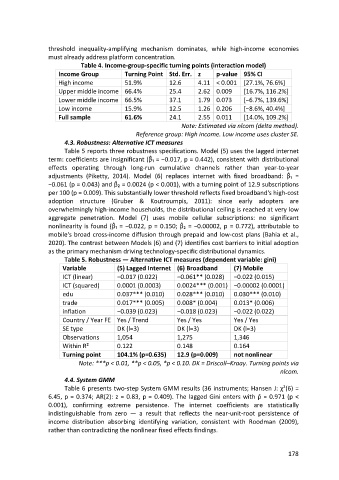
                             Table 4. Income-group-specific turning points (interaction model)
                      Income Group           Turning Point Std. Err. z       p-value 95% CI
                      High income            51.9%          12.6       4.11 < 0.001 [27.1%, 76.6%]
                      Upper middle income 66.4%             25.4       2.62 0.009      [16.7%, 116.2%]
                      Lower middle income 66.5%             37.1       1.79 0.073      [−6.7%, 139.6%]
                      Low income             15.9%          12.5       1.26 0.206      [−8.6%, 40.4%]
                      Full sample            61.6%          24.1       2.55 0.011      [14.0%, 109.2%]
                                                                 Note: Estimated via nlcom (delta method).
                                                 Reference group: High income. Low income uses cluster SE.
                        4.3. Robustness: Alternative ICT measures
                        Table 5 reports three robustness specifications. Model (5) uses the lagged internet
                                                      ̂
                  term: coefficients are insignificant (β₁ = −0.017, p = 0.442), consistent with distributional
                  effects operating through long-run cumulative channels rather than year-to-year
                  adjustments (Piketty, 2014). Model (6) replaces internet with fixed broadband: β₁ =
                                                                                                       ̂
                  −0.061 (p = 0.043) and β₂ = 0.0024 (p < 0.001), with a turning point of 12.9 subscriptions
                                          ̂
                  per 100 (p = 0.009). This substantially lower threshold reflects fixed broadband's high-cost
                  adoption structure (Gruber & Koutroumpis, 2011): since early adopters are
                  overwhelmingly high-income households, the distributional ceiling is reached at very low
                  aggregate penetration. Model (7) uses mobile cellular subscriptions: no significant
                                          ̂
                  nonlinearity is found (β₁ = −0.022, p = 0.150; β₂ = −0.00002, p = 0.772), attributable to
                                                                 ̂
                  mobile's broad cross-income diffusion through prepaid and low-cost plans (Bahia et al.,
                  2020). The contrast between Models (6) and (7) identifies cost barriers to initial adoption
                  as the primary mechanism driving technology-specific distributional dynamics.
                        Table 5. Robustness — Alternative ICT measures (dependent variable: gini)
                       Variable           (5) Lagged Internet (6) Broadband        (7) Mobile
                       ICT (linear)       −0.017 (0.022)       −0.061** (0.028)    −0.022 (0.015)
                       ICT (squared)      0.0001 (0.0003)      0.0024*** (0.001) −0.00002 (0.0001)
                       edu                0.037*** (0.010)     0.028*** (0.010)    0.030*** (0.010)
                       trade              0.017*** (0.005)     0.008* (0.004)      0.013* (0.006)
                       inflation          −0.039 (0.023)       −0.018 (0.023)      −0.022 (0.022)
                       Country / Year FE Yes / Trend           Yes / Yes           Yes / Yes
                       SE type            DK (l=3)             DK (l=3)            DK (l=3)
                       Observations       1,054                1,275               1,346
                       Within R²          0.122                0.148               0.164
                       Turning point      104.1% (p=0.635)     12.9 (p=0.009)      not nonlinear
                             Note: ***p < 0.01, **p < 0.05, *p < 0.10. DK = Driscoll–Kraay. Turning points via
                                                                                                   nlcom.
                        4.4. System GMM
                        Table 6 presents two-step System GMM results (36 instruments; Hansen J: χ²(6) =
                  6.45, p = 0.374; AR(2): z = 0.83, p = 0.409). The lagged Gini enters with ρ̂ = 0.971 (p <
                  0.001), confirming extreme persistence. The internet coefficients are statistically
                  indistinguishable from zero — a result that reflects the near-unit-root persistence of
                  income distribution absorbing identifying variation, consistent with Roodman (2009),
                  rather than contradicting the nonlinear fixed effects findings.


                                                                                                      178

