


Page 180 - ISC PROCEEDINGS 21.4
P. 180
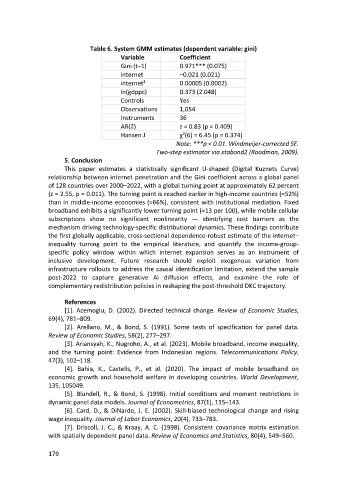
Table 6. System GMM estimates (dependent variable: gini)
                                           Variable             Coefficient
                                           Gini (t−1)           0.971*** (0.075)
                                           internet             −0.021 (0.021)
                                           internet²            0.00005 (0.0002)
                                           ln(gdppc)            0.373 (2.048)
                                           Controls             Yes
                                           Observations         1,054
                                           Instruments          36
                                           AR(2)                z = 0.83 (p = 0.409)
                                           Hansen J             χ²(6) = 6.45 (p = 0.374)
                                                               Note: ***p < 0.01. Windmeijer-corrected SE.
                                                        Two-step estimator via xtabond2 (Roodman, 2009).
                        5. Conclusion
                        This paper estimates a statistically significant U-shaped (Digital Kuznets Curve)
                  relationship between internet penetration and the Gini coefficient across a global panel
                  of 128 countries over 2000–2022, with a global turning point at approximately 62 percent
                  (z = 2.55, p = 0.011). The turning point is reached earlier in high-income countries (≈52%)
                  than in middle-income economies (≈66%), consistent with institutional mediation. Fixed
                  broadband exhibits a significantly lower turning point (≈13 per 100), while mobile cellular
                  subscriptions show no significant nonlinearity — identifying cost barriers as the
                  mechanism driving technology-specific distributional dynamics. These findings contribute
                  the first globally applicable, cross-sectional dependence-robust estimate of the internet–
                  inequality turning point to the empirical literature, and quantify the income-group-
                  specific policy window within which internet expansion serves as an instrument of
                  inclusive development. Future research should exploit exogenous variation from
                  infrastructure rollouts to address the causal identification limitation, extend the sample
                  post-2022 to capture generative AI diffusion effects, and examine the role of
                  complementary redistribution policies in reshaping the post-threshold DKC trajectory.

                        References
                        [1]. Acemoglu, D. (2002). Directed technical change. Review of Economic Studies,
                  69(4), 781–809.
                        [2]. Arellano, M., & Bond, S. (1991). Some tests of specification for panel data.
                  Review of Economic Studies, 58(2), 277–297.
                        [3]. Ariansyah, K., Nugroho, A., et al. (2023). Mobile broadband, income inequality,
                  and the turning point: Evidence from Indonesian regions. Telecommunications Policy,
                  47(3), 102–118.
                        [4]. Bahia, K., Castells, P., et al. (2020). The impact of mobile broadband on
                  economic growth and household welfare in developing countries. World Development,
                  135, 105049.
                        [5]. Blundell, R., & Bond, S. (1998). Initial conditions and moment restrictions in
                  dynamic panel data models. Journal of Econometrics, 87(1), 115–143.
                        [6]. Card, D., & DiNardo, J. E. (2002). Skill-biased technological change and rising
                  wage inequality. Journal of Labor Economics, 20(4), 733–783.
                        [7]. Driscoll, J. C., & Kraay, A. C. (1998). Consistent covariance matrix estimation
                  with spatially dependent panel data. Review of Economics and Statistics, 80(4), 549–560.


                  179

