


Page 75 - ISC PROCEEDINGS 21.4
P. 75
within the economy, thereby catalyzing digital growth. Concurrently, as traditional
                  paradigms are supplanted by technology-platform-based operational models, nascent
                  sectors continuously emerge and undergo robust expansion.
                        3. Research methodology and scope
                        Data for this study were aggregated at the national level from 2019 to 2023 by
                  taking the average of the panel data encompassing 63 provinces and municipalities in
                  Vietnam over the 2018–2023 period. This specific timeframe holds analytical significance
                  as it coincides with the accelerated implementation phase of the National Digital
                  Transformation Strategy (post-2016), thereby capturing the dynamic nature of these
                  socioeconomic impacts more distinctly. Quantitative data sources comprise the Vietnam
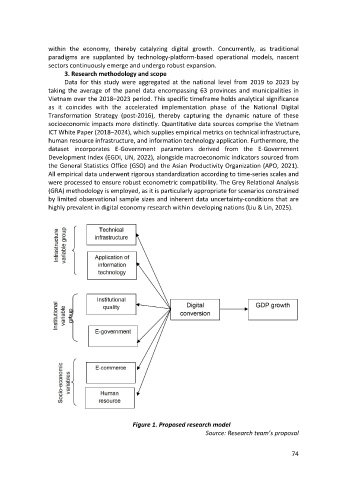
                  ICT White Paper (2018–2024), which supplies empirical metrics on technical infrastructure,
                  human resource infrastructure, and information technology application. Furthermore, the
                  dataset incorporates E-Government parameters derived from the E-Government
                  Development Index (EGDI, UN, 2022), alongside macroeconomic indicators sourced from
                  the General Statistics Office (GSO) and the Asian Productivity Organization (APO, 2021).
                  All empirical data underwent rigorous standardization according to time-series scales and
                  were processed to ensure robust econometric compatibility. The Grey Relational Analysis
                  (GRA) methodology is employed, as it is particularly appropriate for scenarios constrained
                  by limited observational sample sizes and inherent data uncertainty-conditions that are
                  highly prevalent in digital economy research within developing nations (Liu & Lin, 2025).


                                                Figure 1. Proposed research model
                                                                         Source: Research team’s proposal


                                                                                                       74

