


Page 718 - ISC PROCEEDINGS 21.4
P. 718
EffectSize
                      Outcome Indicator         T0         T1         Δ        Test / p
                                                                                              (95% CI)
                   Correct interpretation
                   of I² in meta-analysis    8%         68%        +60 pp    McNemar,       φ = 0.77
                                             (3/37)
                                                        (25/37)
                                                                             p<0.001
                   (%)
                   Correct identification    16%        78%        +62 pp    McNemar,       φ = 0.79
                   of ≥3 confounders (%)     (6/37)     (29/37)              p<0.001


                   Task completion time       135±24    22±8       −83.7%    Paired t,      d = 4.5 (95%
                   (min, mean±SD)                                            p<0.001        CI: 3.2-5.8)

                   Self-confidence (Likert    1.8±0.6   4.1±0.5    +2.3      Wilcoxon,      d = 4.2 (95%
                   1-5, mean±SD)                                             p<0.001        CI: 3.0-5.4)
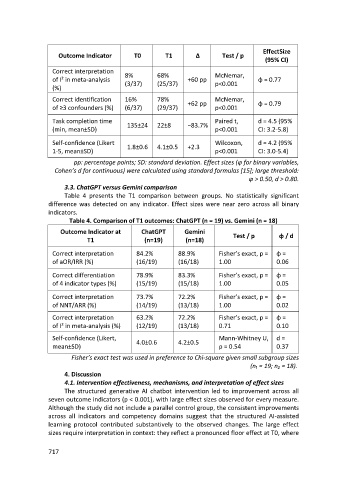
                           pp: percentage points; SD: standard deviation. Effect sizes (φ for binary variables,
                    Cohen’s d for continuous) were calculated using standard formulas [15]; large threshold:
                                                                                        φ > 0.50, d > 0.80.
                        3.3. ChatGPT versus Gemini comparison
                        Table 4 presents the T1 comparison between groups. No statistically significant
                  difference was detected on any indicator. Effect sizes were near zero across all binary
                  indicators.
                         Table 4. Comparison of T1 outcomes: ChatGPT (n = 19) vs. Gemini (n = 18)

                      Outcome Indicator at         ChatGPT        Gemini           Test / p        φ / d
                                T1                  (n=19)        (n=18)
                   Correct interpretation        84.2%          88.9%         Fisher’s exact, p =  φ =
                   of aOR/IRR (%)                (16/19)        (16/18)       1.00                0.06

                   Correct differentiation       78.9%          83.3%         Fisher’s exact, p =  φ =
                   of 4 indicator types (%)      (15/19)        (15/18)       1.00                0.05

                   Correct interpretation        73.7%          72.2%         Fisher’s exact, p =  φ =
                   of NNT/ARR (%)                (14/19)        (13/18)       1.00                0.02
                   Correct interpretation        63.2%          72.2%         Fisher’s exact, p =  φ =
                   of I² in meta-analysis (%)    (12/19)        (13/18)       0.71                0.10

                   Self-confidence (Likert,                                   Mann-Whitney U,     d =
                   mean±SD)                      4.0±0.6        4.2±0.5       p = 0.54            0.37
                          Fisher’s exact test was used in preference to Chi-square given small subgroup sizes
                                                                                         (n₁ = 19; n₂ = 18).
                        4. Discussion
                        4.1. Intervention effectiveness, mechanisms, and interpretation of effect sizes
                        The structured generative AI chatbot intervention led to improvement across all
                  seven outcome indicators (p < 0.001), with large effect sizes observed for every measure.
                  Although the study did not include a parallel control group, the consistent improvements
                  across all indicators and competency domains suggest that the structured AI-assisted
                  learning protocol contributed substantively to the observed changes. The large effect
                  sizes require interpretation in context: they reflect a pronounced floor effect at T0, where


                  717

