


Page 716 - ISC PROCEEDINGS 21.4
P. 716
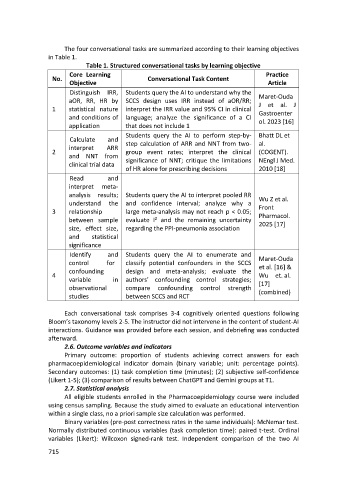
The four conversational tasks are summarized according to their learning objectives
                  in Table 1.
                               Table 1. Structured conversational tasks by learning objective
                         Core Learning                                                        Practice
                   No.                               Conversational Task Content
                         Objective                                                             Article
                          Distinguish  IRR,  Students query the AI to understand why the
                         aOR, RR, HR by      SCCS design uses IRR instead of aOR/RR;        Maret-Ouda
                                                                                               et
                                                                                            J
                                                                                                   al. J
                   1     statistical nature  interpret the IRR value and 95% CI in clinical  Gastroenter
                         and conditions of   language; analyze the significance of a CI
                         application         that does not include 1                        ol. 2023 [16]
                                             Students query the AI to perform step-by-      Bhatt DL et
                          Calculate    and   step calculation of ARR and NNT from two-      al.
                         interpret     ARR
                   2                         group event rates; interpret the clinical      (COGENT).
                         and NNT from
                         clinical trial data  significance of NNT; critique the limitations  NEngl J Med.
                                             of HR alone for prescribing decisions          2010 [18]
                          Read         and
                         interpret   meta-
                         analysis  results;  Students query the AI to interpret pooled RR
                         understand    the   and confidence interval; analyze why a         Wu Z et al.
                                                                                            Front
                   3     relationship        large meta-analysis may not reach p < 0.05;    Pharmacol.
                         between sample      evaluate I² and the remaining uncertainty
                         size, effect size,  regarding the PPI-pneumonia association        2025 [17]
                         and     statistical
                         significance
                          Identify     and   Students query the AI to enumerate and
                         control      for    classify potential confounders in the SCCS     Maret-Ouda
                         confounding         design and meta-analysis; evaluate the         et al. [16] &
                   4                                                                        Wu et. al.
                         variable        in  authors’ confounding control strategies;       [17]
                         observational       compare    confounding    control   strength
                         studies             between SCCS and RCT                           (combined)


                        Each conversational task comprises 3-4 cognitively oriented questions following
                  Bloom’s taxonomy levels 2-5. The instructor did not intervene in the content of student-AI
                  interactions. Guidance was provided before each session, and debriefing was conducted
                  afterward.
                        2.6. Outcome variables and indicators
                        Primary outcome: proportion of students achieving correct answers for each
                  pharmacoepidemiological indicator domain (binary variable; unit: percentage points).
                  Secondary outcomes: (1) task completion time (minutes); (2) subjective self-confidence
                  (Likert 1-5); (3) comparison of results between ChatGPT and Gemini groups at T1.
                        2.7. Statistical analysis
                        All eligible students enrolled in the Pharmacoepidemiology course were included
                  using census sampling. Because the study aimed to evaluate an educational intervention
                  within a single class, no a priori sample size calculation was performed.
                        Binary variables (pre-post correctness rates in the same individuals): McNemar test.
                  Normally distributed continuous variables (task completion time): paired t-test. Ordinal
                  variables (Likert): Wilcoxon signed-rank test. Independent comparison of the two AI

                  715

