


Page 708 - ISC PROCEEDINGS 21.4
P. 708
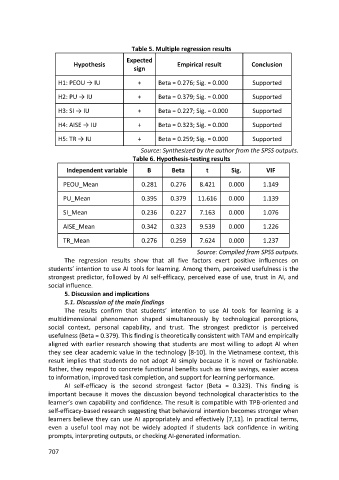
Table 5. Multiple regression results
                                             Expected
                           Hypothesis                          Empirical result          Conclusion
                                                sign

                     H1: PEOU → IU               +       Beta = 0.276; Sig. = 0.000       Supported

                     H2: PU → IU                 +       Beta = 0.379; Sig. = 0.000       Supported

                     H3: SI → IU                 +       Beta = 0.227; Sig. = 0.000       Supported

                     H4: AISE → IU               +       Beta = 0.323; Sig. = 0.000       Supported

                     H5: TR → IU                 +       Beta = 0.259; Sig. = 0.000       Supported

                                                  Source: Synthesized by the author from the SPSS outputs.
                                                Table 6. Hypothesis-testing results
                        Independent variable         B       Beta        t        Sig.         VIF

                       PEOU_Mean                   0.281     0.276     8.421     0.000       1.149

                       PU_Mean                     0.395     0.379     11.616    0.000       1.139


                       SI_Mean                     0.236     0.227     7.163     0.000       1.076

                       AISE_Mean                   0.342     0.323     9.539     0.000       1.226

                       TR_Mean                     0.276     0.259     7.624     0.000       1.237
                                                                      Source: Compiled from SPSS outputs.
                        The regression results show that all five factors exert positive influences on
                  students’ intention to use AI tools for learning. Among them, perceived usefulness is the
                  strongest predictor, followed by AI self-efficacy, perceived ease of use, trust in AI, and
                  social influence.
                        5. Discussion and implications
                        5.1. Discussion of the main findings
                        The results confirm that students’ intention to use AI tools for learning is a
                  multidimensional phenomenon shaped simultaneously by technological perceptions,
                  social context, personal capability, and trust. The strongest predictor is perceived
                  usefulness (Beta = 0.379). This finding is theoretically consistent with TAM and empirically
                  aligned with earlier research showing that students are most willing to adopt AI when
                  they see clear academic value in the technology [8-10]. In the Vietnamese context, this
                  result implies that students do not adopt AI simply because it is novel or fashionable.
                  Rather, they respond to concrete functional benefits such as time savings, easier access
                  to information, improved task completion, and support for learning performance.
                        AI self-efficacy is the second strongest factor (Beta = 0.323). This finding is
                  important because it moves the discussion beyond technological characteristics to the
                  learner’s own capability and confidence. The result is compatible with TPB-oriented and
                  self-efficacy-based research suggesting that behavioral intention becomes stronger when
                  learners believe they can use AI appropriately and effectively [7,11]. In practical terms,
                  even a useful tool may not be widely adopted if students lack confidence in writing
                  prompts, interpreting outputs, or checking AI-generated information.


                  707

