


Page 686 - ISC PROCEEDINGS 21.4
P. 686
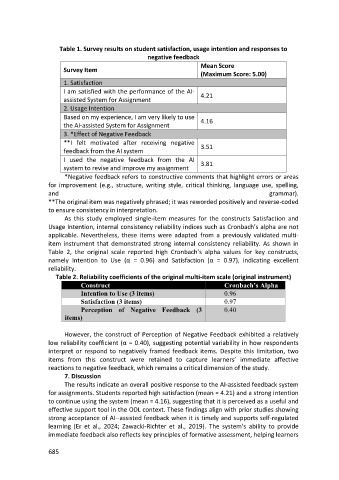
Table 1. Survey results on student satisfaction, usage intention and responses to
                                                     negative feedback
                                                                        Mean Score
                       Survey Item
                                                                        (Maximum Score: 5.00)
                       1. Satisfaction
                       I am satisfied with the performance of the AI-   4.21
                       assisted System for Assignment
                       2. Usage Intention
                       Based on my experience, I am very likely to use  4.16
                       the AI-assisted System for Assignment
                       3. *Effect of Negative Feedback
                       **I felt motivated after receiving negative      3.51
                       feedback from the AI system
                       I used the negative feedback from the AI         3.81
                       system to revise and improve my assignment
                        *Negative feedback refers to constructive comments that highlight errors or areas
                  for improvement (e.g., structure, writing style, critical thinking, language use, spelling,
                  and                                                                           grammar).
                  **The original item was negatively phrased; it was reworded positively and reverse-coded
                  to ensure consistency in interpretation.
                        As this study employed single-item measures for the constructs Satisfaction and
                  Usage Intention, internal consistency reliability indices such as Cronbach’s alpha are not
                  applicable. Nevertheless, these items were adapted from a previously validated multi-
                  item instrument that demonstrated strong internal consistency reliability. As shown in
                  Table 2, the original scale reported high Cronbach’s alpha values for key constructs,
                  namely Intention to Use (α = 0.96) and Satisfaction (α = 0.97), indicating excellent
                  reliability.
                     Table 2. Reliability coefficients of the original multi-item scale (original instrument)
                             Construct                                          Cronbach’s Alpha
                             Intention to Use (3 items)                         0.96
                             Satisfaction (3 items)                             0.97
                             Perception of Negative Feedback (3                 0.40
                        items)


                        However, the construct of Perception of Negative Feedback exhibited a relatively
                  low reliability coefficient (α = 0.40), suggesting potential variability in how respondents
                  interpret or respond to negatively framed feedback items. Despite this limitation, two
                  items from this construct were retained to capture learners’ immediate affective
                  reactions to negative feedback, which remains a critical dimension of the study.
                        7. Discussion
                        The results indicate an overall positive response to the AI-assisted feedback system
                  for assignments. Students reported high satisfaction (mean = 4.21) and a strong intention
                  to continue using the system (mean = 4.16), suggesting that it is perceived as a useful and
                  effective support tool in the ODL context. These findings align with prior studies showing
                  strong acceptance of AI--assisted feedback when it is timely and supports self-regulated
                  learning (Er et al., 2024; Zawacki-Richter et al., 2019). The system’s ability to provide
                  immediate feedback also reflects key principles of formative assessment, helping learners


                  685

