


Page 677 - ISC PROCEEDINGS 21.4
P. 677
4. Results and discussion
                        4.1. Results
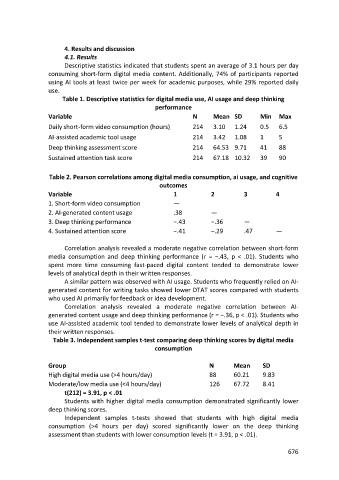
                        Descriptive statistics indicated that students spent an average of 3.1 hours per day
                  consuming short-form digital media content. Additionally, 74% of participants reported
                  using AI tools at least twice per week for academic purposes, while 29% reported daily
                  use.
                       Table 1. Descriptive statistics for digital media use, AI usage and deep thinking
                                                       performance
                  Variable                                           N      Mean SD         Min    Max

                  Daily short-form video consumption (hours)         214    3.10   1.24     0.5    6.5
                  AI-assisted academic tool usage                    214    3.42   1.08     1      5
                  Deep thinking assessment score                     214    64.53 9.71      41     88

                  Sustained attention task score                     214    67.18 10.32     39     90


                  Table 2. Pearson correlations among digital media consumption, ai usage, and cognitive
                                                         outcomes
                  Variable                                    1            2           3          4
                  1. Short-form video consumption             —
                  2. AI-generated content usage               .38          —
                  3. Deep thinking performance                −.43         −.36        —
                  4. Sustained attention score                −.41         −.29        .47        —

                        Correlation analysis revealed a moderate negative correlation between short-form
                  media consumption and deep thinking performance (r = −.43, p < .01). Students who
                  spent more time consuming fast-paced digital content tended to demonstrate lower
                  levels of analytical depth in their written responses.
                        A similar pattern was observed with AI usage. Students who frequently relied on AI-
                  generated content for writing tasks showed lower DTAT scores compared with students
                  who used AI primarily for feedback or idea development.
                        Correlation analysis revealed a moderate negative correlation between AI-
                  generated content usage and deep thinking performance (r = −.36, p < .01). Students who
                  use AI-assisted academic tool tended to demonstrate lower levels of analytical depth in
                  their written responses.
                    Table 3. Independent samples t-test comparing deep thinking scores by digital media
                                                       consumption


                  Group                                                    N       Mean      SD
                  High digital media use (>4 hours/day)                    88      60.21     9.83
                  Moderate/low media use (<4 hours/day)                    126     67.72     8.41
                        t(212) = 3.91, p < .01
                        Students with higher digital media consumption demonstrated significantly lower
                  deep thinking scores.
                        Independent samples t-tests showed that students with high digital media
                  consumption (>4 hours per day) scored significantly lower on the deep thinking
                  assessment than students with lower consumption levels (t = 3.91, p < .01).


                                                                                                      676

