


Page 650 - ISC PROCEEDINGS 21.4
P. 650
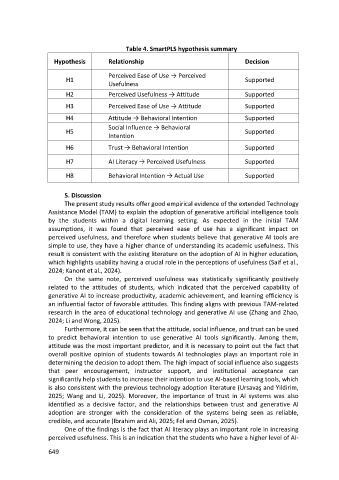
Table 4. SmartPLS hypothesis summary
                    Hypothesis         Relationship                                    Decision


                                       Perceived Ease of Use → Perceived
                        H1                                                             Supported
                                       Usefulness
                        H2             Perceived Usefulness → Attitude                 Supported
                        H3             Perceived Ease of Use → Attitude                Supported

                        H4             Attitude → Behavioral Intention                 Supported
                                       Social Influence → Behavioral
                        H5                                                             Supported
                                       Intention
                        H6             Trust → Behavioral Intention                    Supported

                        H7             AI Literacy → Perceived Usefulness              Supported

                        H8             Behavioral Intention → Actual Use               Supported


                        5. Discussion
                        The present study results offer good empirical evidence of the extended Technology
                  Assistance Model (TAM) to explain the adoption of generative artificial intelligence tools
                  by the students within a digital learning setting. As expected in the initial TAM
                  assumptions, it was found that perceived ease of use has a significant impact on
                  perceived usefulness, and therefore when students believe that generative AI tools are
                  simple to use, they have a higher chance of understanding its academic usefulness. This
                  result is consistent with the existing literature on the adoption of AI in higher education,
                  which highlights usability having a crucial role in the perceptions of usefulness (Saif et al.,
                  2024; Kanont et al., 2024).
                        On the same note, perceived usefulness was statistically significantly positively
                  related to the attitudes of students, which indicated that the perceived capability of
                  generative AI to increase productivity, academic achievement, and learning efficiency is
                  an influential factor of favorable attitudes. This finding aligns with previous TAM-related
                  research in the area of educational technology and generative AI use (Zhang and Zhao,
                  2024; Li and Wong, 2025).
                        Furthermore, it can be seen that the attitude, social influence, and trust can be used
                  to predict behavioral intention to use generative AI tools significantly. Among them,
                  attitude was the most important predictor, and it is necessary to point out the fact that
                  overall positive opinion of students towards AI technologies plays an important role in
                  determining the decision to adopt them. The high impact of social influence also suggests
                  that peer encouragement, instructor support, and institutional acceptance can
                  significantly help students to increase their intention to use AI-based learning tools, which
                  is also consistent with the previous technology adoption literature (Ursavaş and Yildirim,
                  2025; Wang and Li, 2025). Moreover, the importance of trust in AI systems was also
                  identified as a decisive factor, and the relationships between trust and generative AI
                  adoption are stronger with the consideration of the systems being seen as reliable,
                  credible, and accurate (Ibrahim and Ali, 2025; Fel and Osman, 2025).
                        One of the findings is the fact that AI literacy plays an important role in increasing
                  perceived usefulness. This is an indication that the students who have a higher level of AI-

                  649

