


Page 557 - ISC PROCEEDINGS 21.4
P. 557
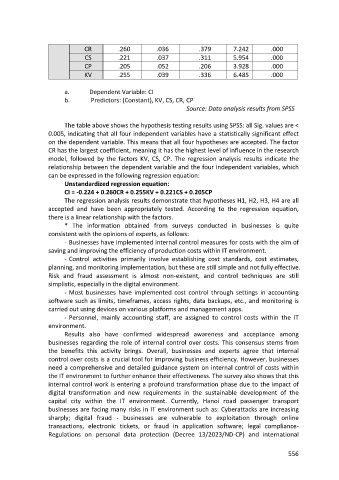
CR          .260         .036           .379        7.242        .000
                               CS          .221         .037           .311        5.954        .000
                               CP          .205         .052           .206        3.928        .000
                               KV          .255         .039           .336        6.485        .000


                        a.      Dependent Variable: CI
                        b.       Predictors: (Constant), KV, CS, CR, CP
                                                                  Source: Data analysis results from SPSS

                        The table above shows the hypothesis testing results using SPSS: all Sig. values are <
                  0.005, indicating that all four independent variables have a statistically significant effect
                  on the dependent variable. This means that all four hypotheses are accepted. The factor
                  CR has the largest coefficient, meaning it has the highest level of influence in the research
                  model, followed by the factors KV, CS, CP. The regression analysis results indicate the
                  relationship between the dependent variable and the four independent variables, which
                  can be expressed in the following regression equation:
                        Unstandardized regression equation:
                        CI = -0.224 + 0.260CR + 0.255KV + 0.221CS + 0.205CP
                        The regression analysis results demonstrate that hypotheses H1, H2, H3, H4 are all
                  accepted and have been appropriately tested. According to the regression equation,
                  there is a linear relationship with the factors.
                        * The information obtained from surveys conducted in businesses is quite
                  consistent with the opinions of experts, as follows:
                        - Businesses have implemented internal control measures for costs with the aim of
                  saving and improving the efficiency of production costs within IT environment.
                        - Control activities primarily involve establishing cost standards, cost estimates,
                  planning, and monitoring implementation, but these are still simple and not fully effective.
                  Risk and fraud assessment is almost non-existent, and control techniques are still
                  simplistic, especially in the digital environment.
                        - Most businesses have implemented cost control through settings in accounting
                  software such as limits, timeframes, access rights, data backups, etc., and monitoring is
                  carried out using devices on various platforms and management apps.
                        - Personnel, mainly accounting staff, are assigned to control costs within the IT
                  environment.
                        Results also have confirmed widespread awareness and acceptance among
                  businesses regarding the role of internal control over costs. This consensus stems from
                  the benefits this activity brings. Overall, businesses and experts agree that internal
                  control over costs is a crucial tool for improving business efficiency. However, businesses
                  need a comprehensive and detailed guidance system on internal control of costs within
                  the IT environment to further enhance their effectiveness. The survey also shows that this
                  internal control work is entering a profound transformation phase due to the impact of
                  digital transformation and new requirements in the sustainable development of the
                  capital city within the IT environment. Currently, Hanoi road passenger transport
                  businesses are facing many risks in IT environment such as: Cyberattacks are increasing
                  sharply; digital fraud - businesses are vulnerable to exploitation through online
                  transactions, electronic tickets, or fraud in application software; legal compliance-
                  Regulations on personal data protection (Decree 13/2023/ND-CP) and international


                                                                                                      556

