


Page 508 - ISC PROCEEDINGS 21.4
P. 508
Year Regulatory instrument / Policy               Key impact

                                                                    sectors
                         Decision No. 810/QD-NHNN: Banking Digital infrastructure targets, digital
                  2021 sector     digital   transformation    plan service   KPIs,  annual   monitoring
                         2025/2030                                  framework

                         Decision    No.   06/QD-TTg:     National Integration of national population
                  2022 population     database    and    e-identity database     with     bank     eKYC;
                         application scheme                         onboarding time reduced to minutes

                         Law   on   Electronic  Transactions   No. Legal     framework      for   digital
                  2023 20/2023/QH15; Decree No. 13/2023/ND- signatures, e-contracts, and user
                         CP on personal data protection             data protection
                         Decree    No.   69/2024/ND-CP     on    e- Remote     onboarding    authorised;
                  2024 identification and authentication; Decision digital    workforce     competency
                         No. 2069/QD-NHNN                           standards codified
                                                                    First dedicated legal space for
                         Decree   No.   94/2025/ND-CP:     Banking
                  2025                                              fintechs and credit institutions to
                         regulatory sandbox
                                                                    pilot new products and models
                           Source: Government of Vietnam; National Assembly; SBV (various years); author’s
                                                                                              compilation.
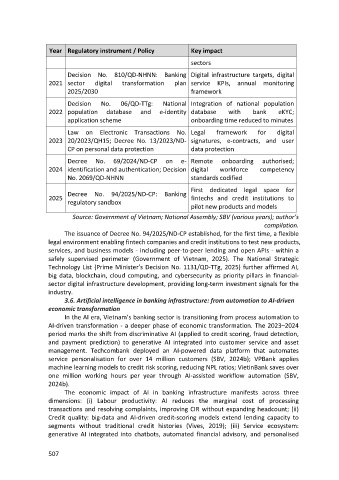
                        The issuance of Decree No. 94/2025/ND-CP established, for the first time, a flexible
                  legal environment enabling fintech companies and credit institutions to test new products,
                  services, and business models - including peer-to-peer lending and open APIs - within a
                  safely supervised perimeter (Government of Vietnam, 2025). The National Strategic
                  Technology List (Prime Minister’s Decision No. 1131/QD-TTg, 2025) further affirmed AI,
                  big data, blockchain, cloud computing, and cybersecurity as priority pillars in financial-
                  sector digital infrastructure development, providing long-term investment signals for the
                  industry.
                        3.6. Artificial intelligence in banking infrastructure: from automation to AI-driven
                  economic transformation
                        In the AI era, Vietnam’s banking sector is transitioning from process automation to
                  AI-driven transformation - a deeper phase of economic transformation. The 2023–2024
                  period marks the shift from discriminative AI (applied to credit scoring, fraud detection,
                  and payment prediction) to generative AI integrated into customer service and asset
                  management. Techcombank deployed an AI-powered data platform that automates
                  service personalisation for over 14 million customers (SBV, 2024b); VPBank applies
                  machine learning models to credit risk scoring, reducing NPL ratios; VietinBank saves over
                  one million working hours per year through AI-assisted workflow automation (SBV,
                  2024b).
                        The economic impact of AI in banking infrastructure manifests across three
                  dimensions: (i) Labour productivity: AI reduces the marginal cost of processing
                  transactions and resolving complaints, improving CIR without expanding headcount; (ii)
                  Credit quality: big-data and AI-driven credit-scoring models extend lending capacity to
                  segments without traditional credit histories (Vives, 2019); (iii) Service ecosystem:
                  generative AI integrated into chatbots, automated financial advisory, and personalised


                  507

