


Page 506 - ISC PROCEEDINGS 21.4
P. 506
growing over 100% annually due to the unified VietQR standard (SBV, 2024b). Many
                  banks now conduct over 90% of transactions digitally (SBV, 2024b).
                        By end-2024, approximately 204.5 million individual payment accounts existed
                  nationwide (SBV, 2024b). Mobile Money reached over 10.2 million accounts, with 72%
                  concentrated in rural and remote areas - demonstrating the geographic reach of digital
                  infrastructure beyond traditional branch networks (SBV, 2024b). Implementation of
                  Project 06 (Prime Minister’s Decision No. 06/QD-TTg, 2022), integrating the national
                  population database with bank eKYC operations, reduced new-customer onboarding time
                  from several days to minutes - an institutionally significant catalyst for financial inclusion.
                        3.3. Digital human capital: foundation and bottleneck
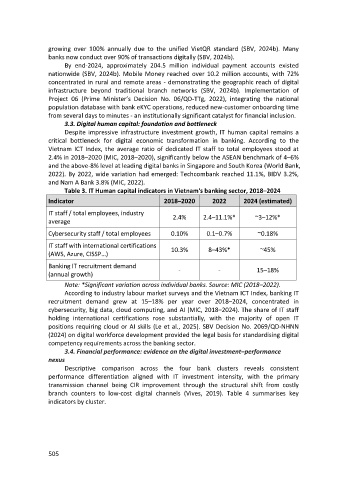
                        Despite impressive infrastructure investment growth, IT human capital remains a
                  critical bottleneck for digital economic transformation in banking. According to the
                  Vietnam ICT Index, the average ratio of dedicated IT staff to total employees stood at
                  2.4% in 2018–2020 (MIC, 2018–2020), significantly below the ASEAN benchmark of 4–6%
                  and the above-8% level at leading digital banks in Singapore and South Korea (World Bank,
                  2022). By 2022, wide variation had emerged: Techcombank reached 11.1%, BIDV 3.2%,
                  and Nam A Bank 3.8% (MIC, 2022).
                        Table 3. IT Human capital indicators in Vietnam's banking sector, 2018–2024
                  Indicator                                2018–2020        2022       2024 (estimated)

                  IT staff / total employees, industry        2.4%      2.4–11.1%*         ~3–12%*
                  average
                  Cybersecurity staff / total employees      0.10%        0.1–0.7%          ~0.18%

                  IT staff with international certifications  10.3%       8–43%*            ~45%
                  (AWS, Azure, CISSP…)
                  Banking IT recruitment demand                 -             -            15–18%
                  (annual growth)
                        Note: *Significant variation across individual banks. Source: MIC (2018–2022).
                        According to industry labour market surveys and the Vietnam ICT Index, banking IT
                  recruitment demand grew at 15–18% per year over 2018–2024, concentrated in
                  cybersecurity, big data, cloud computing, and AI (MIC, 2018–2024). The share of IT staff
                  holding international certifications rose substantially, with the majority of open IT
                  positions requiring cloud or AI skills (Le et al., 2025). SBV Decision No. 2069/QD-NHNN
                  (2024) on digital workforce development provided the legal basis for standardising digital
                  competency requirements across the banking sector.
                        3.4. Financial performance: evidence on the digital investment–performance
                  nexus
                        Descriptive comparison across the four bank clusters reveals consistent
                  performance differentiation aligned with IT investment intensity, with the primary
                  transmission channel being CIR improvement through the structural shift from costly
                  branch counters to low-cost digital channels (Vives, 2019). Table 4 summarises key
                  indicators by cluster.


                  505

