


Page 504 - ISC PROCEEDINGS 21.4
P. 504
Resource-Based View (Barney, 1991) and Digital Business Strategy literature (Bharadwaj
                  et al., 2013) predict that heterogeneous resource endowments - particularly in digital
                  infrastructure and data capabilities - produce persistently differentiated competitive
                  positions, justifying a cluster-based rather than continuous-scale analytical approach.
                  Empirically, the classification reflects the structural segmentation observable in Vietnam’s
                  banking sector: state ownership (C1) creates fundamentally different investment
                  incentive structures, capital allocation mechanisms, and performance mandates relative
                  to private banks (C2–C4); within private banks, business model orientation (enterprise
                  lending vs. retail mass market vs. small institution) drives systematically different digital
                  investment priorities and capability profiles. This typology is consistent with the
                  segmentation adopted in the SBV’s own regulatory and supervisory classifications,
                  enhancing its policy relevance. A key limitation is that cluster assignment is theory-guided
                  rather than data-driven (e.g., k-means clustering), which may introduce subjectivity. To
                  mitigate this, all cluster boundaries are anchored to publicly verifiable thresholds (state
                  ownership status; IT expenditure intensity ≥18% vs. below), reducing discretionary
                  classification. Future research employing latent class or hierarchical cluster analysis could
                  provide a more fully data-driven validation of this typology.
                        While data-driven clustering methods such as k-means or hierarchical clustering
                  could be applied, they require fully standardised and continuous input variables, which
                  are not consistently available in the Vietnamese banking context due to heterogeneous
                  disclosure practices. The threshold-based classification adopted in this study ensures
                  transparency, replicability, and policy relevance, as all classification criteria are anchored
                  in publicly observable indicators. The full distribution of 27 listed banks across the four
                  clusters is as follows: C1 - 4 state-owned banks (BIDV, CTG, VCB, Agribank); C2 - 6
                  enterprise-oriented banks (TCB, MBB, VPB, MSB, SSB, LPB); C3 - 8 retail-oriented banks
                  (ACB, STB, VIB, TPB, HDB, EIB, BVB, KLB); C4 - 9 small and medium-sized banks (NVB, ABB,
                  SGB, BAB, PGB, VBB, BID, NAB, OCB and peers). This distribution is consistent with
                  publicly available listings on HOSE and HNX as of end-2024.
                        3. Results and discussion
                        3.1. Digital infrastructure investment: scale, structure, and development trajectory
                        Vietnam’s banking sector significantly increased digital infrastructure investment
                  over the study period. IT expenditure as a share of operating costs, which stood at 5–7%
                  before 2020, reached 14.85% by 2024, equivalent to approximately VND 32,437 billion
                  system-wide (MIC, 2018–2024). This level approaches the 15–20% international
                  benchmark applied by digital-first banks such as DBS (Singapore) and KakaoBank (South
                  Korea) (World Bank, 2022; Frost, 2020).
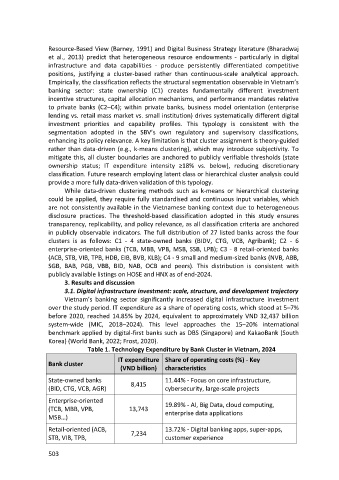
                                Table 1. Technology Expenditure by Bank Cluster in Vietnam, 2024
                                          IT expenditure Share of operating costs (%) - Key
                  Bank cluster
                                           (VND billion)   characteristics
                  State-owned banks            8,415       11.44% - Focus on core infrastructure,
                  (BID, CTG, VCB, AGR)                     cybersecurity, large-scale projects

                  Enterprise-oriented                      19.89% - AI, Big Data, cloud computing,
                  (TCB, MBB, VPB,             13,743       enterprise data applications
                  MSB…)

                  Retail-oriented (ACB,                    13.72% - Digital banking apps, super-apps,
                  STB, VIB, TPB,               7,234       customer experience

                  503

