


Page 459 - ISC PROCEEDINGS 21.4
P. 459
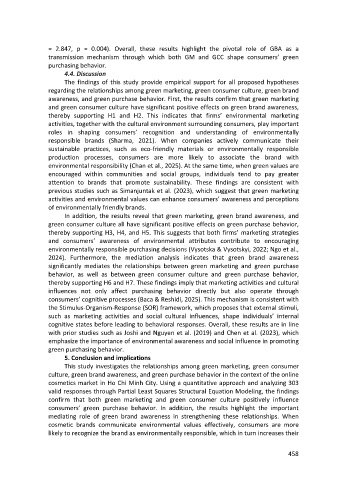
= 2.847, p = 0.004). Overall, these results highlight the pivotal role of GBA as a
                  transmission mechanism through which both GM and GCC shape consumers’ green
                  purchasing behavior.
                        4.4. Discussion
                        The findings of this study provide empirical support for all proposed hypotheses
                  regarding the relationships among green marketing, green consumer culture, green brand
                  awareness, and green purchase behavior. First, the results confirm that green marketing
                  and green consumer culture have significant positive effects on green brand awareness,
                  thereby supporting H1 and H2. This indicates that firms’ environmental marketing
                  activities, together with the cultural environment surrounding consumers, play important
                  roles in shaping consumers’ recognition and understanding of environmentally
                  responsible brands (Sharma, 2021). When companies actively communicate their
                  sustainable practices, such as eco-friendly materials or environmentally responsible
                  production processes, consumers are more likely to associate the brand with
                  environmental responsibility (Chan et al., 2025). At the same time, when green values are
                  encouraged within communities and social groups, individuals tend to pay greater
                  attention to brands that promote sustainability. These findings are consistent with
                  previous studies such as Simanjuntak et al. (2023), which suggest that green marketing
                  activities and environmental values can enhance consumers’ awareness and perceptions
                  of environmentally friendly brands.
                        In addition, the results reveal that green marketing, green brand awareness, and
                  green consumer culture all have significant positive effects on green purchase behavior,
                  thereby supporting H3, H4, and H5. This suggests that both firms’ marketing strategies
                  and consumers’ awareness of environmental attributes contribute to encouraging
                  environmentally responsible purchasing decisions (Vysotska & Vysotskyi, 2022; Ngo et al.,
                  2024). Furthermore, the mediation analysis indicates that green brand awareness
                  significantly mediates the relationships between green marketing and green purchase
                  behavior, as well as between green consumer culture and green purchase behavior,
                  thereby supporting H6 and H7. These findings imply that marketing activities and cultural
                  influences not only affect purchasing behavior directly but also operate through
                  consumers’ cognitive processes (Baca & Reshidi, 2025). This mechanism is consistent with
                  the Stimulus-Organism-Response (SOR) framework, which proposes that external stimuli,
                  such as marketing activities and social cultural influences, shape individuals’ internal
                  cognitive states before leading to behavioral responses. Overall, these results are in line
                  with prior studies such as Joshi and Nguyen et al. (2019) and Chen et al. (2023), which
                  emphasize the importance of environmental awareness and social influence in promoting
                  green purchasing behavior.
                        5. Conclusion and implications
                        This study investigates the relationships among green marketing, green consumer
                  culture, green brand awareness, and green purchase behavior in the context of the online
                  cosmetics market in Ho Chi Minh City. Using a quantitative approach and analyzing 303
                  valid responses through Partial Least Squares Structural Equation Modeling, the findings
                  confirm that both green marketing and green consumer culture positively influence
                  consumers’ green purchase behavior. In addition, the results highlight the important
                  mediating role of green brand awareness in strengthening these relationships. When
                  cosmetic brands communicate environmental values effectively, consumers are more
                  likely to recognize the brand as environmentally responsible, which in turn increases their


                                                                                                      458

