


Page 458 - ISC PROCEEDINGS 21.4
P. 458
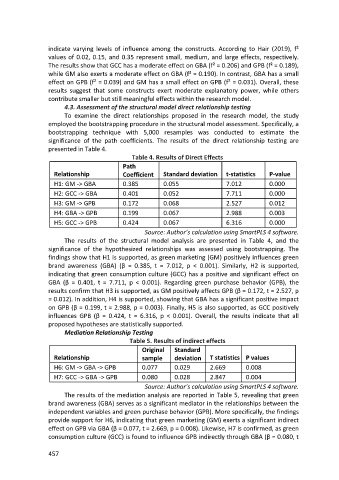
indicate varying levels of influence among the constructs. According to Hair (2019), f²
                  values of 0.02, 0.15, and 0.35 represent small, medium, and large effects, respectively.
                  The results show that GCC has a moderate effect on GBA (f² = 0.206) and GPB (f² = 0.189),
                  while GM also exerts a moderate effect on GBA (f² = 0.190). In contrast, GBA has a small
                  effect on GPB (f² = 0.039) and GM has a small effect on GPB (f² = 0.031). Overall, these
                  results suggest that some constructs exert moderate explanatory power, while others
                  contribute smaller but still meaningful effects within the research model.
                        4.3. Assessment of the structural model direct relationship testing
                        To examine the direct relationships proposed in the research model, the study
                  employed the bootstrapping procedure in the structural model assessment. Specifically, a
                  bootstrapping technique with 5,000 resamples was conducted to estimate the
                  significance of the path coefficients. The results of the direct relationship testing are
                  presented in Table 4.
                                               Table 4. Results of Direct Effects
                                            Path
                    Relationship            Coefficient   Standard deviation    t-statistics    P-value
                    H1: GM -> GBA           0.385         0.055                 7.012           0.000
                    H2: GCC -> GBA          0.401         0.052                 7.711           0.000

                    H3: GM -> GPB           0.172         0.068                 2.527           0.012
                    H4: GBA -> GPB          0.199         0.067                 2.988           0.003
                    H5: GCC -> GPB          0.424         0.067                 6.316           0.000
                                                    Source: Author’s calculation using SmartPLS 4 software.
                        The results of the structural model analysis are presented in Table 4, and the
                  significance of the hypothesized relationships was assessed using bootstrapping. The
                  findings show that H1 is supported, as green marketing (GM) positively influences green
                  brand awareness (GBA) (β = 0.385, t = 7.012, p < 0.001). Similarly, H2 is supported,
                  indicating that green consumption culture (GCC) has a positive and significant effect on
                  GBA (β = 0.401, t = 7.711, p < 0.001). Regarding green purchase behavior (GPB), the
                  results confirm that H3 is supported, as GM positively affects GPB (β = 0.172, t = 2.527, p
                  = 0.012). In addition, H4 is supported, showing that GBA has a significant positive impact
                  on GPB (β = 0.199, t = 2.988, p = 0.003). Finally, H5 is also supported, as GCC positively
                  influences GPB (β = 0.424, t = 6.316, p < 0.001). Overall, the results indicate that all
                  proposed hypotheses are statistically supported.
                        Mediation Relationship Testing
                                               Table 5. Results of indirect effects
                                                   Original   Standard
                    Relationship                   sample     deviation    T statistics P values

                    H6: GM -> GBA -> GPB           0.077      0.029        2.669       0.008
                    H7: GCC -> GBA -> GPB          0.080      0.028        2.847       0.004
                                                    Source: Author’s calculation using SmartPLS 4 software.
                        The results of the mediation analysis are reported in Table 5, revealing that green
                  brand awareness (GBA) serves as a significant mediator in the relationships between the
                  independent variables and green purchase behavior (GPB). More specifically, the findings
                  provide support for H6, indicating that green marketing (GM) exerts a significant indirect
                  effect on GPB via GBA (β = 0.077, t = 2.669, p = 0.008). Likewise, H7 is confirmed, as green
                  consumption culture (GCC) is found to influence GPB indirectly through GBA (β = 0.080, t

                  457

