


Page 447 - ISC PROCEEDINGS 21.4
P. 447
4.2.5. Multiple regression analysis
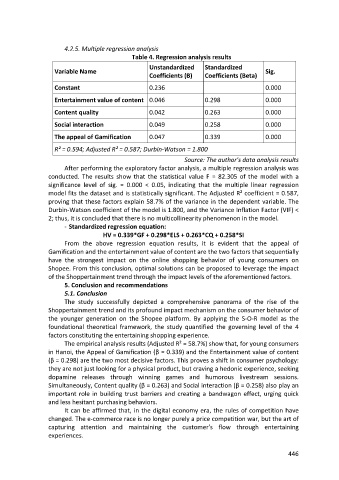
                                               Table 4. Regression analysis results

                                                     Unstandardized      Standardized
                    Variable Name                                                             Sig.
                                                     Coefficients (B)    Coefficients (Beta)
                    Constant                         0.236                                    0.000

                    Entertainment value of content 0.046                 0.298                0.000

                    Content quality                  0.042               0.263                0.000
                    Social interaction               0.049               0.258                0.000

                    The appeal of Gamification       0.047               0.339                0.000

                    R² = 0.594; Adjusted R² = 0.587; Durbin-Watson = 1.800
                                                                  Source: The author's data analysis results
                        After performing the exploratory factor analysis, a multiple regression analysis was
                  conducted. The results show that the statistical value F = 82.305 of the model with a
                  significance level of sig. = 0.000 < 0.05, indicating that the multiple linear regression
                  model fits the dataset and is statistically significant. The Adjusted R² coefficient = 0.587,
                  proving that these factors explain 58.7% of the variance in the dependent variable. The
                  Durbin-Watson coefficient of the model is 1.800, and the Variance Inflation Factor (VIF) <
                  2; thus, it is concluded that there is no multicollinearity phenomenon in the model.
                        - Standardized regression equation:
                                     HV = 0.339*GF + 0.298*ELS + 0.263*CQ + 0.258*SI
                        From the above regression equation results, it is evident that the appeal of
                  Gamification and the entertainment value of content are the two factors that sequentially
                  have the strongest impact on the online shopping behavior of young consumers on
                  Shopee. From this conclusion, optimal solutions can be proposed to leverage the impact
                  of the Shoppertainment trend through the impact levels of the aforementioned factors.
                        5. Conclusion and recommendations
                        5.1. Conclusion
                        The study successfully depicted a comprehensive panorama of the rise of the
                  Shoppertainment trend and its profound impact mechanism on the consumer behavior of
                  the younger generation on the Shopee platform. By applying the S-O-R model as the
                  foundational theoretical framework, the study quantified the governing level of the 4
                  factors constituting the entertaining shopping experience.
                        The empirical analysis results (Adjusted R² = 58.7%) show that, for young consumers
                  in Hanoi, the Appeal of Gamification (β = 0.339) and the Entertainment value of content
                  (β = 0.298) are the two most decisive factors. This proves a shift in consumer psychology:
                  they are not just looking for a physical product, but craving a hedonic experience, seeking
                  dopamine releases through winning games and humorous livestream sessions.
                  Simultaneously, Content quality (β = 0.263) and Social interaction (β = 0.258) also play an
                  important role in building trust barriers and creating a bandwagon effect, urging quick
                  and less hesitant purchasing behaviors.
                        It can be affirmed that, in the digital economy era, the rules of competition have
                  changed. The e-commerce race is no longer purely a price competition war, but the art of
                  capturing attention and maintaining the customer's flow through entertaining
                  experiences.


                                                                                                      446

