


Page 351 - ISC PROCEEDINGS 21.4
P. 351
because customs procedures, platform data, and logistics processes are more tightly
                  connected. The practical consequence is not only stronger enforcement capacity, but also
                  faster institutional learning because pilot zones serve as regulatory laboratories.
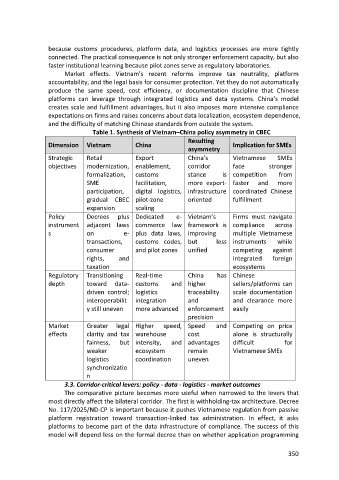
                        Market effects. Vietnam’s recent reforms improve tax neutrality, platform
                  accountability, and the legal basis for consumer protection. Yet they do not automatically
                  produce the same speed, cost efficiency, or documentation discipline that Chinese
                  platforms can leverage through integrated logistics and data systems. China’s model
                  creates scale and fulfillment advantages, but it also imposes more intensive compliance
                  expectations on firms and raises concerns about data localization, ecosystem dependence,
                  and the difficulty of matching Chinese standards from outside the system.
                                  Table 1. Synthesis of Vietnam–China policy asymmetry in CBEC
                                                                   Resulting
                  Dimension     Vietnam          China                             Implication for SMEs
                                                                   asymmetry
                  Strategic     Retail           Export            China’s         Vietnamese     SMEs
                  objectives    modernization, enablement,         corridor        face        stronger
                                formalization,   customs           stance      is competition      from
                                SME              facilitation,     more export- faster      and    more
                                participation,   digital logistics, infrastructure coordinated Chinese
                                gradual  CBEC pilot-zone           oriented        fulfillment
                                expansion        scaling
                  Policy        Decrees   plus Dedicated       e- Vietnam’s        Firms must navigate
                  instrument    adjacent laws commerce       law framework is compliance          across
                  s             on          e- plus data laws, improving           multiple Vietnamese
                                transactions,    customs codes, but          less instruments     while
                                consumer         and pilot zones   unified         competing     against
                                rights,    and                                     integrated    foreign
                                taxation                                           ecosystems
                  Regulatory    Transitioning    Real-time         China     has Chinese
                  depth         toward   data- customs       and higher            sellers/platforms can
                                driven control; logistics          traceability    scale documentation
                                interoperabilit  integration       and             and clearance more
                                y still uneven   more advanced     enforcement     easily
                                                                   precision
                  Market        Greater   legal Higher    speed, Speed       and Competing on price
                  effects       clarity and tax warehouse          cost            alone is structurally
                                fairness,  but intensity,    and advantages        difficult         for
                                weaker           ecosystem         remain          Vietnamese SMEs
                                logistics        coordination      uneven
                                synchronizatio
                                n
                        3.3. Corridor-critical levers: policy - data - logistics - market outcomes
                        The comparative picture becomes more useful when narrowed to the levers that
                  most directly affect the bilateral corridor. The first is withholding-tax architecture. Decree
                  No. 117/2025/ND-CP is important because it pushes Vietnamese regulation from passive
                  platform registration toward transaction-linked tax administration. In effect, it asks
                  platforms to become part of the data infrastructure of compliance. The success of this
                  model will depend less on the formal decree than on whether application programming


                                                                                                      350

