


Page 275 - ISC PROCEEDINGS 21.4
P. 275
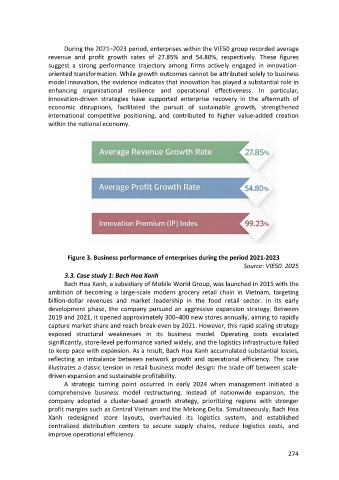
During the 2021–2023 period, enterprises within the VIE50 group recorded average
                  revenue and profit growth rates of 27.85% and 54.80%, respectively. These figures
                  suggest a strong performance trajectory among firms actively engaged in innovation-
                  oriented transformation. While growth outcomes cannot be attributed solely to business
                  model innovation, the evidence indicates that innovation has played a substantial role in
                  enhancing organizational resilience and operational effectiveness. In particular,
                  innovation-driven strategies have supported enterprise recovery in the aftermath of
                  economic disruptions, facilitated the pursuit of sustainable growth, strengthened
                  international competitive positioning, and contributed to higher value-added creation
                  within the national economy.


                         Figure 3. Business performance of enterprises during the period 2021-2023
                                                                                       Source: VIE50. 2025
                        3.3. Case study 1: Bach Hoa Xanh
                        Bach Hoa Xanh, a subsidiary of Mobile World Group, was launched in 2015 with the
                  ambition of becoming a large-scale modern grocery retail chain in Vietnam, targeting
                  billion-dollar revenues and market leadership in the food retail sector. In its early
                  development phase, the company pursued an aggressive expansion strategy. Between
                  2019 and 2021, it opened approximately 300–400 new stores annually, aiming to rapidly
                  capture market share and reach break-even by 2021. However, this rapid scaling strategy
                  exposed structural weaknesses in its business model. Operating costs escalated
                  significantly, store-level performance varied widely, and the logistics infrastructure failed
                  to keep pace with expansion. As a result, Bach Hoa Xanh accumulated substantial losses,
                  reflecting an imbalance between network growth and operational efficiency. The case
                  illustrates a classic tension in retail business model design: the trade-off between scale-
                  driven expansion and sustainable profitability.
                        A strategic turning point occurred in early 2024 when management initiated a
                  comprehensive business model restructuring. Instead of nationwide expansion, the
                  company adopted a cluster-based growth strategy, prioritizing regions with stronger
                  profit margins such as Central Vietnam and the Mekong Delta. Simultaneously, Bach Hoa
                  Xanh redesigned store layouts, overhauled its logistics system, and established
                  centralized distribution centers to secure supply chains, reduce logistics costs, and
                  improve operational efficiency.


                                                                                                      274

