


Page 274 - ISC PROCEEDINGS 21.4
P. 274
Innovation is increasingly recognized as a key strategic driver of business
                  performance and competitive capability among Vietnamese enterprises. Rather than
                  being limited to new product development, innovation manifests in broader
                  organizational transformation, including process optimization, digital technology adoption,
                  and the restructuring of business models. This multidimensional approach to innovation
                  enables firms not only to enhance operational efficiency but also to strengthen value
                  creation mechanisms and adapt more effectively to dynamic market conditions.
                        In 2024, as many as 86% of surveyed enterprises identified innovation as the most
                  critical growth driver for the next three to five years, primarily focusing on product
                  development, technological advancement, process improvement, and human capital
                  enhancement. This represents a noticeable increase from 83.2% in 2023, reflecting a
                  growing recognition of innovation as a strategic priority amid intensifying competition
                  and deeper international integration. The distribution of innovative enterprises is
                  relatively diversified, with concentration across seven major sectors: information
                  technology and telecommunications; banking; oil, gas, energy, and electricity; insurance;
                  food and beverages; retail; and real estate and construction. Notably, leading
                  corporations such as Viettel, FPT, Vinamilk, Vingroup, and Masan simultaneously exhibit
                  high levels of innovation and superior business performance, illustrating an effective
                  alignment between technological strategy and financial management. Similarly, major
                  banking institutions including Vietcombank and BIDV as well as insurance providers such
                  as Bao Viet Life, have strengthened their competitive positions through service
                  digitalization, big data analytics, and online platform deployment, thereby enhancing
                  operational efficiency and reinforcing customer trust. In heavy industry and energy
                  sectors, enterprises such as PetroVietnam and Hoa Phat Group have pursued process
                  innovation and expansion into renewable energy, signaling a broader shift toward
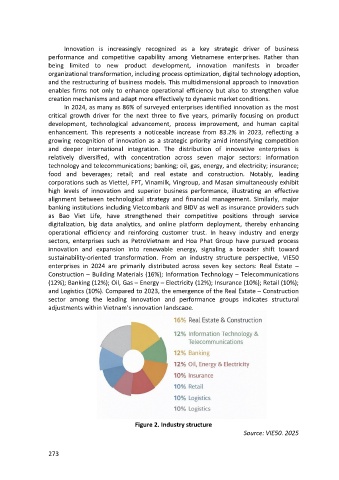
                  sustainability-oriented transformation. From an industry structure perspective, VIE50
                  enterprises in 2024 are primarily distributed across seven key sectors: Real Estate –
                  Construction – Building Materials (16%); Information Technology – Telecommunications
                  (12%); Banking (12%); Oil, Gas – Energy – Electricity (12%); Insurance (10%); Retail (10%);
                  and Logistics (10%). Compared to 2023, the emergence of the Real Estate – Construction
                  sector among the leading innovation and performance groups indicates structural
                  adjustments within Vietnam’s innovation landscape.


                                                Figure 2. Industry structure
                                                                                       Source: VIE50. 2025


                  273

