


Page 246 - ISC PROCEEDINGS 21.4
P. 246
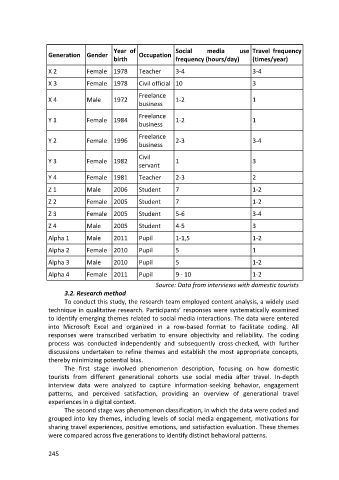
Year of               Social     media      use Travel frequency
                  Generation Gender               Occupation
                                         birth                 frequency (hours/day)      (times/year)
                  X 2           Female 1978       Teacher      3-4                        3-4

                  X 3           Female 1978       Civil official 10                       3

                                                  Freelance
                  X 4           Male     1972                  1-2                        1
                                                  business
                                                  Freelance
                  Y 1           Female 1984                    1-2                        1
                                                  business

                                                  Freelance
                  Y 2           Female 1996                    2-3                        3-4
                                                  business
                                                  Civil
                  Y 3           Female 1982                    1                          3
                                                  servant

                  Y 4           Female 1981       Teacher      2-3                        2
                  Z 1           Male     2006     Student      7                          1-2

                  Z 2           Female 2005       Student      7                          1-2

                  Z 3           Female 2005       Student      5-6                        3-4
                  Z 4           Male     2005     Student      4-5                        3

                  Alpha 1       Male     2011     Pupil        1-1,5                      1-2

                  Alpha 2       Female 2010       Pupil        5                          1
                  Alpha 3       Male     2010     Pupil        5                          1-2

                  Alpha 4       Female 2011       Pupil        9 - 10                     1-2
                                                        Source: Data from interviews with domestic tourists
                        3.2. Research method
                        To conduct this study, the research team employed content analysis, a widely used
                  technique in qualitative research. Participants’ responses were systematically examined
                  to identify emerging themes related to social media interactions. The data were entered
                  into Microsoft Excel and organized in a row-based format to facilitate coding. All
                  responses were transcribed verbatim to ensure objectivity and reliability. The coding
                  process was conducted independently and subsequently cross-checked, with further
                  discussions undertaken to refine themes and establish the most appropriate concepts,
                  thereby minimizing potential bias.
                        The first stage involved phenomenon description, focusing on how domestic
                  tourists from different generational cohorts use social media after travel. In-depth
                  interview data were analyzed to capture information-seeking behavior, engagement
                  patterns, and perceived satisfaction, providing an overview of generational travel
                  experiences in a digital context.
                        The second stage was phenomenon classification, in which the data were coded and
                  grouped into key themes, including levels of social media engagement, motivations for
                  sharing travel experiences, positive emotions, and satisfaction evaluation. These themes
                  were compared across five generations to identify distinct behavioral patterns.


                  245

