


Page 245 - ISC PROCEEDINGS 21.4
P. 245
2.2.4. The moderating role of generational cohorts
                        Since the social media practices and motivations are sharply varied across
                  generational cohorts, differences are expected in how individuals engage with social
                  media and how such engagement influences their emotional responses and satisfaction.
                        → Research Question 4: How do generational differences shape the relationship
                  between social media interaction, positive emotions, and travel satisfaction?
                        3. Methodology
                        3.1 Data source
                        Research data were collected through semi-structured interviews conducted with
                  study participants. This method was chosen for its flexibility in combining guiding
                  questions with open-ended discussions, enabling in-depth exploration of participants’
                  perspectives, perceptions, and underlying motivations. All interviews were conducted in
                  Vietnamese to avoid language barriers, with only the researcher and interviewee present
                  to ensure data integrity.
                        A non-probability sampling approach was employed, combining purposive and
                  quota sampling. Purposive sampling ensured participants met specific criteria: (1)
                  Vietnamese nationality, (2) at least one domestic trip within the past six months, and (3)
                  engagement in social media after travel. Quota sampling was applied to achieve
                  generational representation across five cohorts: Baby Boomers, Generation X, Generation
                  Y, Generation Z, and Generation Alpha, with four participants in each group (N = 20).
                        Ethical standards were strictly observed, particularly for minor participants in
                  Generation Alpha. In accordance with Vietnam’s Law on Children (2016), parental or
                  guardian consent and participant assent were obtained. Participants were informed of
                  their rights, including voluntary participation and withdrawal. All data were anonymized,
                  securely stored, and used solely for academic purposes.
                        A total of 20 participants were interviewed between December 27, 2025, and
                  January 29, 2026. Each interview lasted between 25 and 30 minutes and was audio-
                  recorded and transcribed verbatim with consent. Data collection continued until
                  saturation was reached. The sample was evenly distributed across generations to support
                  comparative analysis of intergenerational differences in tourism perceptions and
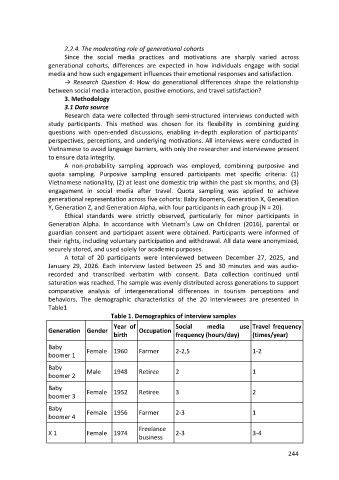
                  behaviors. The demographic characteristics of the 20 interviewees are presented in
                  Table1
                                        Table 1. Demographics of interview samples
                                         Year of               Social     media      use Travel frequency
                  Generation Gender               Occupation
                                         birth                 frequency (hours/day)      (times/year)

                  Baby          Female 1960       Farmer       2-2,5                      1-2
                  boomer 1

                  Baby          Male     1948     Retiree      2                          1
                  boomer 2

                  Baby          Female 1952       Retiree      3                          2
                  boomer 3
                  Baby          Female 1956       Farmer       2-3                        1
                  boomer 4

                                                  Freelance
                  X 1           Female 1974                    2-3                        3-4
                                                  business

                                                                                                      244

