


Page 226 - ISC PROCEEDINGS 21.4
P. 226
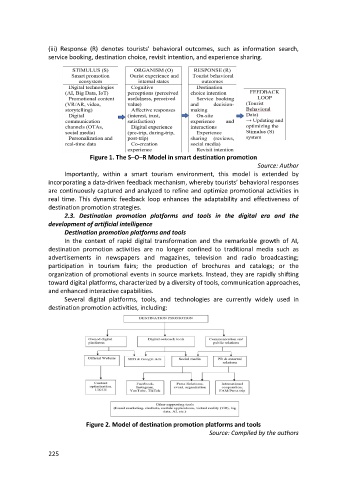
(iii) Response (R) denotes tourists’ behavioral outcomes, such as information search,
                  service booking, destination choice, revisit intention, and experience sharing.


                                 Figure 1. The S–O–R Model in smart destination promotion
                                                                                            Source: Author
                        Importantly, within a smart tourism environment, this model is extended by
                  incorporating a data-driven feedback mechanism, whereby tourists’ behavioral responses
                  are continuously captured and analyzed to refine and optimize promotional activities in
                  real time. This dynamic feedback loop enhances the adaptability and effectiveness of
                  destination promotion strategies.
                        2.3. Destination promotion platforms and tools in the digital era and the
                  development of artificial intelligence
                        Destination promotion platforms and tools
                        In the context of rapid digital transformation and the remarkable growth of AI,
                  destination promotion activities are no longer confined to traditional media such as
                  advertisements in newspapers and magazines, television and radio broadcasting;
                  participation in tourism fairs; the production of brochures and catalogs; or the
                  organization of promotional events in source markets. Instead, they are rapidly shifting
                  toward digital platforms, characterized by a diversity of tools, communication approaches,
                  and enhanced interactive capabilities.
                        Several digital platforms, tools, and technologies are currently widely used in
                  destination promotion activities, including:


                               Figure 2. Model of destination promotion platforms and tools
                                                                           Source: Compiled by the authors


                  225

