


Page 216 - ISC PROCEEDINGS 21.4
P. 216
3. Results and discussion
                        3.1. Reliability testing
                                           Table 2. Cronbach’s Alpha test results

                        Latent variables          Cronbach’s Alpha    Corrected Item- Total Correlation

                     Information Quality (IQ)           0.884                   0.692 - 0.745

                      System Quality (SyQ)              0.860                   0.610 - 0.753


                      Service Quality (SeQ)             0.869                   0.653 - 0.779

                  Trust in e-government (TRU)           0.903                   0.708 - 0.788
                                                                   Source: Research team’s synthesis, 2026
                        It is apparent from this table that the Cronbach’s Alpha coefficients of all the factors
                  satisfied the cutoff of 0.7 and every Corrected Item - Total Correlation excessed 0.3,
                  which were acceptable according to Robinson et al., (1991). These results suggest that all
                  the scales possess internal consistency.
                        3.2. Evaluating the relationships of independent variables
                        Key fit index values reached commonly accepted thresholds, including χ²/df=4.835
                  (≤ 5), SRMR =0.047 ≤ (0.08), even recommended thresholds such as CFI = 0.923 (≥ 0.9), TLI
                  = 0.905 (≥ 0.9) (Hu & Bentler, 1999). It is worth noting that regarding RMSEA, this index
                  reached 0.096 (> 0.08 và < 0.1) - which is mediocre acceptable (MacCallum et al., 1996).
                  However, Chen et al. (2008) stated that an universal cutoff for this index was unnecessary,
                  which confirms that the proposed research model is a good fit for the collected data.
                        3.3. Evaluating the hypothesised model


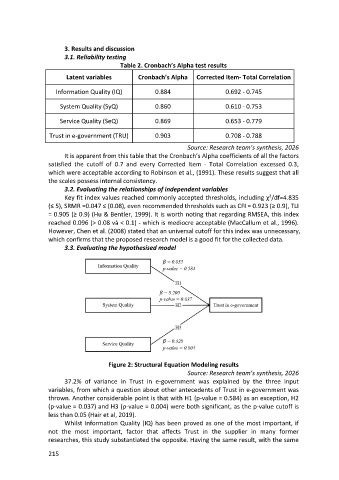
                                       Figure 2: Structural Equation Modeling results
                                                                   Source: Research team’s synthesis, 2026
                        37.2% of variance in Trust in e-government was explained by the three input
                  variables, from which a question about other antecedents of Trust in e-government was
                  thrown. Another considerable point is that with H1 (p-value = 0.584) as an exception, H2
                  (p-value = 0.037) and H3 (p-value = 0.004) were both significant, as the p-value cutoff is
                  less than 0.05 (Hair et al, 2019).
                        Whilst Information Quality (IQ) has been proved as one of the most important, if
                  not the most important, factor that affects Trust in the supplier in many former
                  researches, this study substantiated the opposite. Having the same result, with the same

                  215

