


Page 215 - ISC PROCEEDINGS 21.4
P. 215
Data collected were analyzed and processed using Microsoft Excel 2016, SPSS 26.0,
                  and AMOS 20.0 in accordance with a number of rigorous steps to establish the research
                  model’s reliability and validity. First, Cronbach’s Alpha was calculated for each
                  measurement scale to analyze the degree to which the observed variables representing
                  the same constructs were closely aligned with one another. Secondly, the measurement
                  model was validated using Confirmatory Factor Analysis (CFA) by testing the goodness-of-
                  fit of the empirical data to the theoretical model, the structural model was examined
                  through Structural Equation Modeling (SEM) in order to analyze the directional
                  relationships between the variable(s). In this analysis, the standardized coefficient (β)
                  indicates the magnitude of the independent variable’s effect on the dependent variable,
                  and the p-value indicates the statistical significance of the respective relationship of the
                  variable(s).
                        Descriptive Statistics of the Study Sample
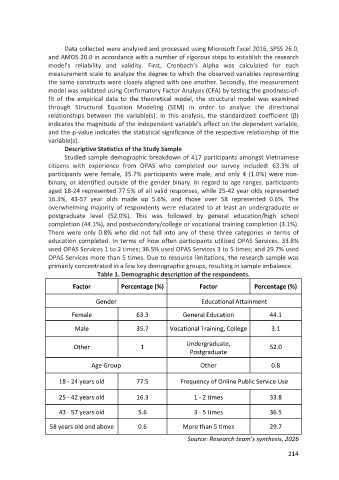
                        Studied sample demographic breakdown of 417 participants amongst Vietnamese
                  citizens with experience from OPAS who completed our survey included: 63.3% of
                  participants were female, 35.7% participants were male, and only 4 (1.0%) were non-
                  binary, or identified outside of the gender binary. In regard to age ranges, participants
                  aged 18-24 represented 77.5% of all valid responses, while 25-42 year olds represented
                  16.3%, 43-57 year olds made up 5.6%, and those over 58 represented 0.6%. The
                  overwhelming majority of respondents were educated to at least an undergraduate or
                  postgraduate level (52.0%). This was followed by general education/high school
                  completion (44.1%), and postsecondary/college or vocational training completion (3.1%).
                  There were only 0.8% who did not fall into any of these three categories in terms of
                  education completed. In terms of how often participants utilized OPAS Services, 33.8%
                  used OPAS Services 1 to 2 times; 36.5% used OPAS Services 3 to 5 times; and 29.7% used
                  OPAS Services more than 5 times. Due to resource limitations, the research sample was
                  primarily concentrated in a few key demographic groups, resulting in sample imbalance.
                                   Table 1. Demographic description of the respondents.

                           Factor           Percentage (%)             Factor             Percentage (%)

                                   Gender                               Educational Attainment

                          Female                 63.3            General Education              44.1

                           Male                  35.7        Vocational Training, College       3.1


                           Other                  1               Undergraduate,                52.0
                                                                    Postgraduate

                                 Age Group                             Other                    0.8

                      18 - 24 years old          77.5           Frequency of Online Public Service Use


                      25 - 42 years old          16.3                1 - 2 times                33.8

                      43 - 57 years old           5.6                3 - 5 times                36.5

                  58 years old and above          0.6            More than 5 times              29.7

                                                                   Source: Research team’s synthesis, 2026

                                                                                                      214

