


Page 213 - ISC PROCEEDINGS 21.4
P. 213
H2: A more positive citizen evaluation of the System Quality of online public administrative
                  services will strengthen their trust in e-government.
                        Numerous recent studies have shown that service quality affects the level of trust
                  citizens have in e-government services (Hooda et al., 2023; Lee et al., 2011;
                  Taufiqurokhman et al., 2024). An online administrative process that provides users with
                  both comprehensive information and stable system operations helps to improve users'
                  experiences and creates higher satisfaction with the service, and thus will ultimately
                  develop people's trust in digital government architecture. Therefore, the research team
                  hypothesizes:
                  H3: A more positive citizen evaluation of the Service Quality of online public administrative
                  services will strengthen their trust in e-government.
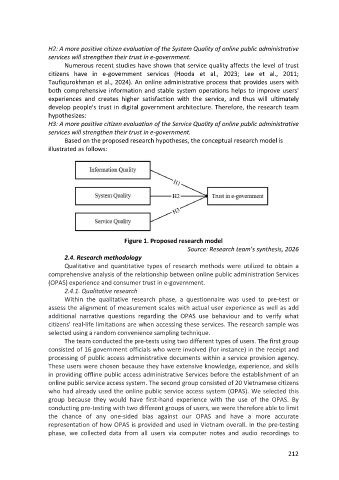
                        Based on the proposed research hypotheses, the conceptual research model is
                  illustrated as follows:


                                             Figure 1. Proposed research model
                                                                   Source: Research team’s synthesis, 2026
                        2.4. Research methodology
                        Qualitative and quantitative types of research methods were utilized to obtain a
                  comprehensive analysis of the relationship between online public administration Services
                  (OPAS) experience and consumer trust in e-government.
                        2.4.1. Qualitative research
                        Within the qualitative research phase, a questionnaire was used to pre-test or
                  assess the alignment of measurement scales with actual user experience as well as add
                  additional narrative questions regarding the OPAS use behaviour and to verify what
                  citizens' real-life limitations are when accessing these services. The research sample was
                  selected using a random convenience sampling technique.
                        The team conducted the pre-tests using two different types of users. The first group
                  consisted of 16 government officials who were involved (for instance) in the receipt and
                  processing of public access administrative documents within a service provision agency.
                  These users were chosen because they have extensive knowledge, experience, and skills
                  in providing offline public access administrative Services before the establishment of an
                  online public service access system. The second group consisted of 20 Vietnamese citizens
                  who had already used the online public service access system (OPAS). We selected this
                  group because they would have first-hand experience with the use of the OPAS. By
                  conducting pre-testing with two different groups of users, we were therefore able to limit
                  the chance of any one-sided bias against our OPAS and have a more accurate
                  representation of how OPAS is provided and used in Vietnam overall. In the pre-testing
                  phase, we collected data from all users via computer notes and audio recordings to


                                                                                                      212

