


Page 812 - ISC PROCEEDINGS 21.4
P. 812
Outer
                                  Observed variables                                α      CR      AVE
                                                                        loading
                  PEOU1: I find digital technology easy to use in
                  teaching.                                              0.894
                  PEOU2: I do not encounter difficulties when using
                  digital technology for teaching.                       0.785    0.799   0.882   0.714
                  PEOU3: I feel confident when using digital
                  technology in teaching.                                0.853
                  Perceived Usefulness (PU)
                  PU1: Digital technology helps me teach more            0.836
                  effectively.
                  PU2: Using digital technology helps improve my         0.911
                  teaching quality.                                               0.870   0.912   0.721
                  PU3: Digital technology helps me deliver lesson        0.841
                  content more clearly.
                  PU4: Digital technology helps me save time in lesson   0.805
                  preparation.
                  Institutional Support (Support)
                  Support1: My institution provides adequate facilities  0.919
                  for digital technology use.                                     0.801   0.910   0.834
                  Support2: My institution organizes training courses    0.907
                  on the use of digital technology in teaching.
                  Perceived Accounting Teaching Quality (TQ)
                  TQ1: Digital technology helps me deliver lesson        0.718
                  content more effectively.
                  TQ2: I can interact better with students thanks to     0.695
                  digital technology.
                  TQ3: Students highly appreciate my teaching            0.718    0.776   0.848   0.527
                  methods that integrate digital technology.
                  TQ4: Digital technology helps me improve student       0.724
                  assessment and evaluation.
                  TQ5: I am satisfied with my teaching quality when      0.774
                  using digital technology.
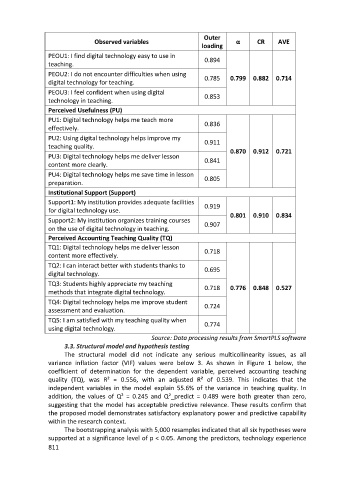
                                                      Source: Data processing results from SmartPLS software
                        3.3. Structural model and hypothesis testing
                        The structural model did not indicate any serious multicollinearity issues, as all
                  variance inflation factor (VIF) values were below 3. As shown in Figure 1 below, the
                  coefficient of determination for the dependent variable, perceived accounting teaching
                  quality (TQ), was R² = 0.556, with an adjusted R² of 0.539. This indicates that the
                  independent variables in the model explain 55.6% of the variance in teaching quality. In
                  addition, the values of Q² = 0.245 and Q²_predict = 0.489 were both greater than zero,
                  suggesting that the model has acceptable predictive relevance. These results confirm that
                  the proposed model demonstrates satisfactory explanatory power and predictive capability
                  within the research context.
                        The bootstrapping analysis with 5,000 resamples indicated that all six hypotheses were
                  supported at a significance level of p < 0.05. Among the predictors, technology experience
                  811

