


Page 803 - ISC PROCEEDINGS 21.4
P. 803
Digital organisational culture (DC)
                        Osmundsen et al. (2018) indicate that organisational culture plays a supportive role in
                  facilitating digital transformation within organisations. Organisational culture influences the
                  level of readiness to accept change and adopt new technologies. A working environment
                  that encourages innovation and continuous learning can create favourable conditions for the
                  implementation of digital transformation in accounting. Therefore, the following hypothesis
                  is proposed:
                        H6: Digital organisational culture positively influences digital transformation in
                  accounting in private universities.
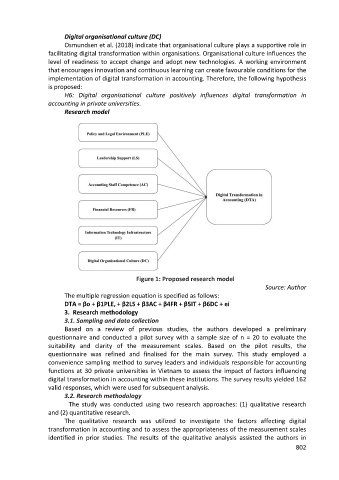
                        Research model


                                                 Figure 1: Proposed research model
                                                                                              Source: Author
                        The multiple regression equation is specified as follows:
                        DTA = βo + β1PLE, + β2LS + β3AC + β4FR + β5IT + β6DC + ei
                        3. Research methodology
                        3.1. Sampling and data collection
                        Based on a review of previous studies, the authors developed a preliminary
                  questionnaire and conducted a pilot survey with a sample size of n = 20 to evaluate the
                  suitability and clarity of the measurement scales. Based on the pilot results, the
                  questionnaire was refined and finalised for the main survey. This study employed a
                  convenience sampling method to survey leaders and individuals responsible for accounting
                  functions at 30 private universities in Vietnam to assess the impact of factors influencing
                  digital transformation in accounting within these institutions. The survey results yielded 162
                  valid responses, which were used for subsequent analysis.
                        3.2. Research methodology
                         The study was conducted using two research approaches: (1) qualitative research
                  and (2) quantitative research.
                        The qualitative research was utilized to investigate the factors affecting digital
                  transformation in accounting and to assess the appropriateness of the measurement scales
                  identified in prior studies. The results of the qualitative analysis assisted the authors in
                                                                                                         802

