


Page 644 - ISC PROCEEDINGS 21.4
P. 644
technologies by the users. Research shows that students who place their faith in AI
                  systems tend to use AI-generated written works and use generative AI-based applications
                  in their educational activities (Fel and Osman, 2025; Ibrahim and Ali, 2025).
                        Also, AI literacy and digital competence are significant in determining adoption of
                  generative AI technologies by students. Higher technological knowledge and AI literacy
                  allow students to see more possibilities and limitations of AI tools, which leads to a
                  positive impact on their attitude to usefulness and readiness to use the technologies in
                  the academic setting (Sergeeva and Ivanov, 2025; Zhou and Chen, 2023).
                        Several other determinants considered as a result of recent empirical studies are
                  perceived risk, facilitating conditions, and technological innovativeness, which also
                  determine the adoption of generative AI. The said factors affect the perception of
                  students towards the generative AI technologies and have an effect on their behavioral
                  intentions to implement AI tools in digital learning settings (Chen et al., 2023; Jin and Li,
                  2025).
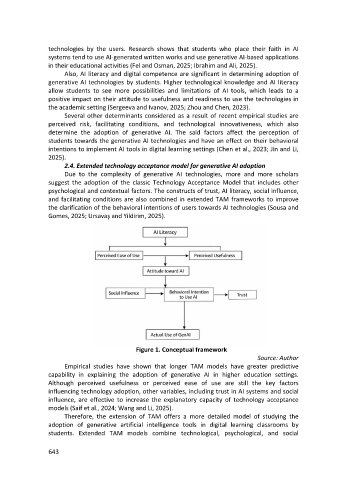
                        2.4. Extended technology acceptance model for generative AI adoption
                        Due to the complexity of generative AI technologies, more and more scholars
                  suggest the adoption of the classic Technology Acceptance Model that includes other
                  psychological and contextual factors. The constructs of trust, AI literacy, social influence,
                  and facilitating conditions are also combined in extended TAM frameworks to improve
                  the clarification of the behavioral intentions of users towards AI technologies (Sousa and
                  Gomes, 2025; Ursavaş and Yildirim, 2025).


                                                 Figure 1. Conceptual framework
                                                                                           Source: Author
                        Empirical studies have shown that longer TAM models have greater predictive
                  capability in explaining the adoption of generative AI in higher education settings.
                  Although perceived usefulness or perceived ease of use are still the key factors
                  influencing technology adoption, other variables, including trust in AI systems and social
                  influence, are effective to increase the explanatory capacity of technology acceptance
                  models (Saif et al., 2024; Wang and Li, 2025).
                        Therefore, the extension of TAM offers a more detailed model of studying the
                  adoption of generative artificial intelligence tools in digital learning classrooms by
                  students. Extended TAM models combine technological, psychological, and social


                  643

