


Page 482 - ISC PROCEEDINGS 21.4
P. 482
4.3. Transformer & attention-based generators
                        Transformer and attention-based generators use self-attention to capture long-
                  range dependencies and cross-series interactions, improving reproduction of long-
                  memory effects, cross-asset correlations, and structural regime shifts when trained on
                  sufficiently long windows; examples include transformer-augmented GANs and hybrid
                  diffusion/attention frameworks, which typically deliver stronger long-horizon fidelity at
                  the cost of higher compute, larger data requirements, and careful regularization to avoid
                  overfitting. where the Transformers serve multiple generative roles in financial data
                  synthesis, from autoregressive order generators to attention modules inside GANs and
                  diffusion frameworks like MarketGPT (Wheeler, A. & Varner, J. D., 2024), TTS-GAN (Li, X.
                  et al., 2022), BankGAN (Mehri, H. et al., 2024), TF-CoDiT(Zhang, F. et al., 2025).
                        4.4. Privacy-focused variants
                        Privacy-focused Financial GANs integrate differential privacy, federated learning, or
                  constraint-aware discriminators to limit disclosure while producing useful synthetic data
                  for loan-default modeling, fraud detection, audits, and cross-institutional sharing; these
                  variants, NVF-DPGAN(Zhang, Y. et al., 2026), Fed-DPSDG-WGAN (Ramachandra, P. &
                  Vaithiyanathan, S., 2025), enable measurable privacy–utility tradeoffs but require careful
                  tuning and often additional techniques (e.g., tail-augmentation or post-processing) to
                  preserve extreme events and regulatory-relevant risk metrics.
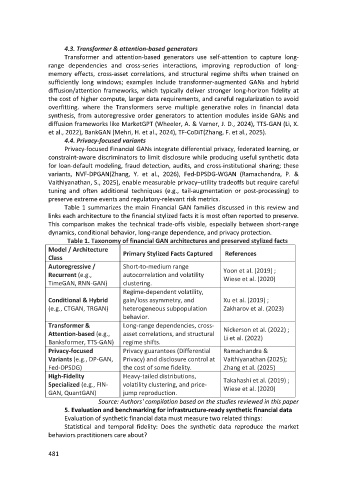
                        Table 1 summarizes the main Financial GAN families discussed in this review and
                  links each architecture to the financial stylized facts it is most often reported to preserve.
                  This comparison makes the technical trade-offs visible, especially between short-range
                  dynamics, conditional behavior, long-range dependence, and privacy protection.
                         Table 1. Taxonomy of financial GAN architectures and preserved stylized facts
                  Model / Architecture      Primary Stylized Facts Captured     References
                  Class
                  Autoregressive /          Short-to-medium range               Yoon et al. (2019) ;
                  Recurrent (e.g.,          autocorrelation and volatility
                  TimeGAN, RNN-GAN)         clustering.                         Wiese et al. (2020)
                                            Regime-dependent volatility,
                  Conditional & Hybrid      gain/loss asymmetry, and            Xu et al. (2019) ;
                  (e.g., CTGAN, TRGAN)      heterogeneous subpopulation         Zakharov et al. (2023)
                                            behavior.
                  Transformer &             Long-range dependencies, cross-     Nickerson et al. (2022) ;
                  Attention-based (e.g.,    asset correlations, and structural  Li et al. (2022)
                  Banksformer, TTS-GAN)     regime shifts.
                  Privacy-focused           Privacy guarantees (Differential    Ramachandra &
                  Variants (e.g., DP-GAN,   Privacy) and disclosure control at  Vaithiyanathan (2025);
                  Fed-DPSDG)                the cost of some fidelity.          Zhang et al. (2025)
                  High-Fidelity             Heavy-tailed distributions,         Takahashi et al. (2019) ;
                  Specialized (e.g., FIN-   volatility clustering, and price-   Wiese et al. (2020)
                  GAN, QuantGAN)            jump reproduction.
                                    Source: Authors' compilation based on the studies reviewed in this paper
                        5. Evaluation and benchmarking for infrastructure-ready synthetic financial data
                        Evaluation of synthetic financial data must measure two related things:
                        Statistical and temporal fidelity: Does the synthetic data reproduce the market
                  behaviors practitioners care about?


                  481

