


Page 131 - ISC PROCEEDINGS 21.4
P. 131
digital jobs, supported by a local workforce that is both adaptable and proficient. From
                  the standpoint of the digital economy, the NIP emphasizes meeting community needs,
                  particularly in terms of consumption, and focuses on developing applications and services
                  centered around digital solutions. Additionally, the NIP aims to boost investment in digital
                  infrastructure, such as digital identification and secure digital signing. Other areas of focus
                  include cloud computing, big data and AI, content management, and IoT. Ultimately, the
                  NIP is crafted to enhance digital connectivity and infrastructure within Malaysia (Jusoh &
                  Abd Razak, 2025).
                        In 2021, Malaysia launched the 12th Malaysia Plan 2021–2025 (12MP), which
                  targets crucial areas like economic growth and environmental sustainability. Within the
                  digital economy sector, the 12MP addresses challenges such as insufficient digital
                  equipment and services, as well as fragmented governance. This plan also seeks to bridge
                  the digital divide, increase investment in research and development, and improve the
                  adoption of new technological tools. In 2023, Malaysia introduced the National Industrial
                  Master Plan 2030 (NIMP 2030), which lays out a detailed strategy for advancing the
                  country's manufacturing sector until 2030. Each year, Malaysia's internet-based sector is
                  projected to contribute RM257.2 billion (US$61.3 billion) to the economy by 2030 (Jusoh
                  & Abd Razak, 2025). Consequently, Malaysia is focusing on promoting digitalization,
                  cultivating digital skills among its population, and encouraging digital trade activities. The
                  country's efforts to establish digital platforms as a major economic contributor are
                  supported by its international commitments, as evidenced by its involvement in the
                  Regional Comprehensive Economic Partnership (RCEP) and the Comprehensive and
                  Progressive Agreement for Trans-Pacific Partnership (CPTPP).
                        The digital transformation in this Southeast Asian nation has achieved significant
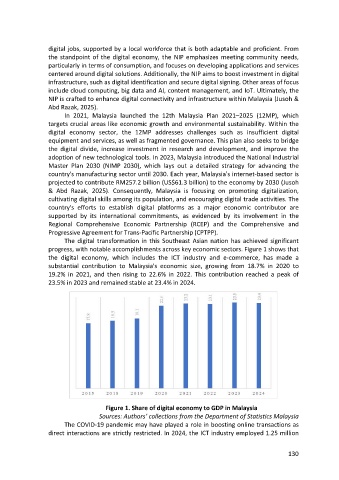
                  progress, with notable accomplishments across key economic sectors. Figure 1 shows that
                  the digital economy, which includes the ICT industry and e-commerce, has made a
                  substantial contribution to Malaysia's economic size, growing from 18.7% in 2020 to
                  19.2% in 2021, and then rising to 22.6% in 2022. This contribution reached a peak of
                  23.5% in 2023 and remained stable at 23.4% in 2024.


                                      Figure 1. Share of digital economy to GDP in Malaysia
                                    Sources: Authors’ collections from the Department of Statistics Malaysia
                        The COVID-19 pandemic may have played a role in boosting online transactions as
                  direct interactions are strictly restricted. In 2024, the ICT industry employed 1.25 million


                                                                                                      130

