


Page 95 - ISC PROCEEDINGS 21.4
P. 95
In emerging economies such as Vietnam, these challenges highlight the importance
                  of policy frameworks that support digital transformation, innovation, and skill
                  development. Overall, the literature indicates strong interconnections between AI
                  adoption, innovation capability, and export competitiveness, but integrated frameworks
                  incorporating institutional factors remain underdeveloped.
                        3. Conceptual framework and research approach
                        This study proposes a conceptual framework in which artificial intelligence (AI)
                  adoption functions as a technological driver, innovation capability serves as a mediating
                  mechanism, and institutional alignment acts as a moderating factor influencing export
                  competitiveness.
                        AI adoption enhances firms’ data processing capacity, predictive analytics
                  capabilities, and decision-making efficiency (Brynjolfsson & McAfee, 2014; Acemoglu &
                  Restrepo, 2018). However, technological adoption alone does not guarantee improved
                  export performance. The ability of firms to translate technological inputs into value-
                  added outputs depends on their innovation capability (Schumpeter, 1934; Teece et al.,
                  1997).
                        In this framework, innovation capability mediates the relationship between AI
                  adoption and export competitiveness. Firms that integrate AI into research and
                  development, production processes, and market intelligence are more likely to achieve
                  sustained competitiveness in international markets (Cockburn et al., 2018; Aghion et al.,
                  2021).
                        Institutional alignment moderates this relationship. Supportive regulatory
                  environments, digital infrastructure, and policy coherence strengthen the impact of AI
                  adoption on innovation outcomes, whereas fragmented institutional structures may
                  constrain transformation (Lundvall, 1992; OECD, 2023).
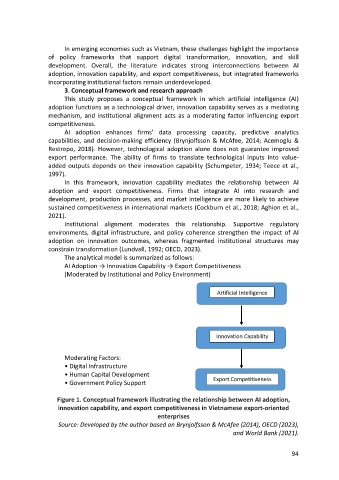
                        The analytical model is summarized as follows:
                        AI Adoption → Innovation Capability → Export Competitiveness
                        (Moderated by Institutional and Policy Environment)


                        Moderating Factors:
                        • Digital Infrastructure
                        • Human Capital Development
                        • Government Policy Support

                     Figure 1. Conceptual framework illustrating the relationship between AI adoption,
                     innovation capability, and export competitiveness in Vietnamese export-oriented
                                                        enterprises
                     Source: Developed by the author based on Brynjolfsson & McAfee (2014), OECD (2023),
                                                                                   and World Bank (2021).


                                                                                                       94

