


Page 68 - ISC PROCEEDINGS 21.4
P. 68
AI to PIE monitoring should be approached as a comprehensive institutional reform
                  strategy rather than a standalone technological solution.
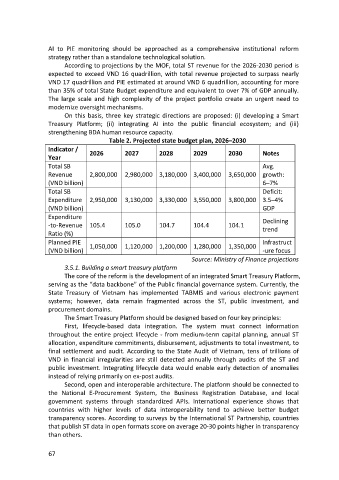
                        According to projections by the MOF, total ST revenue for the 2026-2030 period is
                  expected to exceed VND 16 quadrillion, with total revenue projected to surpass nearly
                  VND 17 quadrillion and PIE estimated at around VND 6 quadrillion, accounting for more
                  than 35% of total State Budget expenditure and equivalent to over 7% of GDP annually.
                  The large scale and high complexity of the project portfolio create an urgent need to
                  modernize oversight mechanisms.
                        On this basis, three key strategic directions are proposed: (i) developing a Smart
                  Treasury Platform; (ii) integrating AI into the public financial ecosystem; and (iii)
                  strengthening BDA human resource capacity.
                                       Table 2. Projected state budget plan, 2026–2030
                  Indicator /    2026        2027        2028        2029        2030        Notes
                  Year
                  Total SB                                                                   Avg.
                  Revenue        2,800,000   2,980,000 3,180,000 3,400,000       3,650,000 growth:
                  (VND billion)                                                              6–7%
                  Total SB                                                                   Deficit:
                  Expenditure    2,950,000   3,130,000 3,330,000 3,550,000       3,800,000 3.5–4%
                  (VND billion)                                                              GDP
                  Expenditure                                                                Declining
                  -to-Revenue    105.4       105.0       104.7       104.4       104.1
                  Ratio (%)                                                                  trend
                  Planned PIE                                                                Infrastruct
                  (VND billion)  1,050,000   1,120,000 1,200,000 1,280,000       1,350,000   -ure focus
                                                                    Source: Ministry of Finance projections
                        3.5.1. Building a smart treasury platform
                        The core of the reform is the development of an integrated Smart Treasury Platform,
                  serving as the “data backbone” of the Public financial governance system. Currently, the
                  State Treasury of Vietnam has implemented TABMIS and various electronic payment
                  systems; however, data remain fragmented across the ST, public investment, and
                  procurement domains.
                        The Smart Treasury Platform should be designed based on four key principles:
                        First, lifecycle-based data integration. The system must connect information
                  throughout the entire project lifecycle - from medium-term capital planning, annual ST
                  allocation, expenditure commitments, disbursement, adjustments to total investment, to
                  final settlement and audit. According to the State Audit of Vietnam, tens of trillions of
                  VND in financial irregularities are still detected annually through audits of the ST and
                  public investment. Integrating lifecycle data would enable early detection of anomalies
                  instead of relying primarily on ex-post audits.
                        Second, open and interoperable architecture. The platform should be connected to
                  the National E-Procurement System, the Business Registration Database, and local
                  government systems through standardized APIs. International experience shows that
                  countries with higher levels of data interoperability tend to achieve better budget
                  transparency scores. According to surveys by the International ST Partnership, countries
                  that publish ST data in open formats score on average 20-30 points higher in transparency
                  than others.


                  67

