


Page 670 - ISC PROCEEDINGS 21.4
P. 670
the modification of synaptic connections between neurons. Understanding these
                  mechanisms not only helps explain how the brain functions but also provides a scientific
                  basis for designing more effective learning methods.
                        2.1.1. The process of long-term memory formation
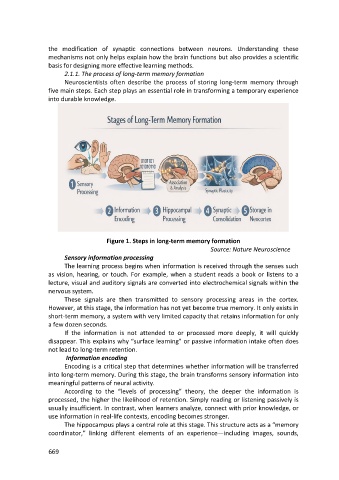
                        Neuroscientists often describe the process of storing long-term memory through
                  five main steps. Each step plays an essential role in transforming a temporary experience
                  into durable knowledge.


                                      Figure 1. Steps in long-term memory formation
                                                                           Source: Nature Neuroscience
                        Sensory information processing
                        The learning process begins when information is received through the senses such
                  as vision, hearing, or touch. For example, when a student reads a book or listens to a
                  lecture, visual and auditory signals are converted into electrochemical signals within the
                  nervous system.
                        These signals are then transmitted to sensory processing areas in the cortex.
                  However, at this stage, the information has not yet become true memory. It only exists in
                  short-term memory, a system with very limited capacity that retains information for only
                  a few dozen seconds.
                        If the information is not attended to or processed more deeply, it will quickly
                  disappear. This explains why “surface learning” or passive information intake often does
                  not lead to long-term retention.
                        Information encoding
                        Encoding is a critical step that determines whether information will be transferred
                  into long-term memory. During this stage, the brain transforms sensory information into
                  meaningful patterns of neural activity.
                        According to the “levels of processing” theory, the deeper the information is
                  processed, the higher the likelihood of retention. Simply reading or listening passively is
                  usually insufficient. In contrast, when learners analyze, connect with prior knowledge, or
                  use information in real-life contexts, encoding becomes stronger.
                        The hippocampus plays a central role at this stage. This structure acts as a “memory
                  coordinator,” linking different elements of an experience—including images, sounds,


                  669

