


Page 60 - ISC PROCEEDINGS 21.4
P. 60
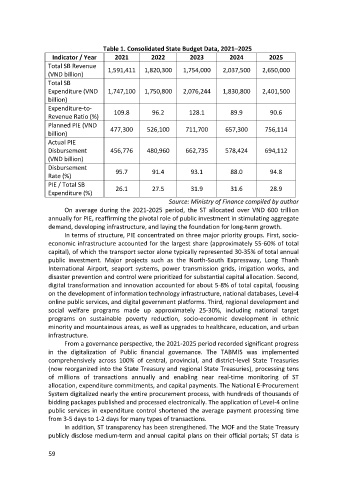
Table 1. Consolidated State Budget Data, 2021–2025
                   Indicator / Year      2021         2022          2023          2024          2025
                  Total SB Revenue     1,591,411    1,820,300    1,754,000     2,037,500     2,650,000
                  (VND billion)
                  Total SB
                  Expenditure (VND     1,747,100    1,750,800    2,076,244     1,830,800     2,401,500
                  billion)
                  Expenditure-to-
                  Revenue Ratio (%)      109.8        96.2         128.1          89.9          90.6
                  Planned PIE (VND      477,300      526,100      711,700       657,300       756,114
                  billion)
                  Actual PIE
                  Disbursement          456,776      480,960      662,735       578,424       694,112
                  (VND billion)
                  Disbursement
                  Rate (%)                95.7        91.4          93.1          88.0          94.8
                  PIE / Total SB
                  Expenditure (%)         26.1        27.5          31.9          31.6          28.9
                                                            Source: Ministry of Finance compiled by author
                        On average during the 2021-2025 period, the ST allocated over VND 600 trillion
                  annually for PIE, reaffirming the pivotal role of public investment in stimulating aggregate
                  demand, developing infrastructure, and laying the foundation for long-term growth.
                        In terms of structure, PIE concentrated on three major priority groups. First, socio-
                  economic infrastructure accounted for the largest share (approximately 55-60% of total
                  capital), of which the transport sector alone typically represented 30-35% of total annual
                  public investment. Major projects such as the North-South Expressway, Long Thanh
                  International Airport, seaport systems, power transmission grids, irrigation works, and
                  disaster prevention and control were prioritized for substantial capital allocation. Second,
                  digital transformation and innovation accounted for about 5-8% of total capital, focusing
                  on the development of information technology infrastructure, national databases, Level-4
                  online public services, and digital government platforms. Third, regional development and
                  social welfare programs made up approximately 25-30%, including national target
                  programs on sustainable poverty reduction, socio-economic development in ethnic
                  minority and mountainous areas, as well as upgrades to healthcare, education, and urban
                  infrastructure.
                        From a governance perspective, the 2021-2025 period recorded significant progress
                  in the digitalization of Public financial governance. The TABMIS was implemented
                  comprehensively across 100% of central, provincial, and district-level State Treasuries
                  (now reorganized into the State Treasury and regional State Treasuries), processing tens
                  of millions of transactions annually and enabling near real-time monitoring of ST
                  allocation, expenditure commitments, and capital payments. The National E-Procurement
                  System digitalized nearly the entire procurement process, with hundreds of thousands of
                  bidding packages published and processed electronically. The application of Level-4 online
                  public services in expenditure control shortened the average payment processing time
                  from 3-5 days to 1-2 days for many types of transactions.
                        In addition, ST transparency has been strengthened. The MOF and the State Treasury
                  publicly disclose medium-term and annual capital plans on their official portals; ST data is


                  59

