


Page 401 - ISC PROCEEDINGS 21.4
P. 401
interactions can strengthen SMEs’ digital transformation capacity and marketing
                  performance on e-commerce platforms.
                        3. Conceptual framework development
                        3.1. Theoretical foundation of the integrated Triple-Helix digital ecosystem
                        In the context of the digital economy and the rapid diffusion of artificial intelligence
                  (AI), the transformation of marketing activities among small and medium-sized
                  enterprises (SMEs) can no longer be explained solely by firm-level capabilities. Instead, it
                  increasingly reflects the outcome of multi-actor interaction within a digitally embedded
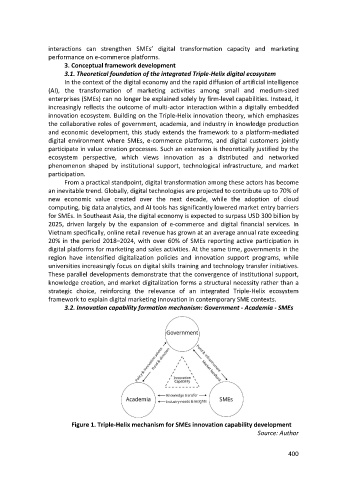
                  innovation ecosystem. Building on the Triple-Helix innovation theory, which emphasizes
                  the collaborative roles of government, academia, and industry in knowledge production
                  and economic development, this study extends the framework to a platform-mediated
                  digital environment where SMEs, e-commerce platforms, and digital customers jointly
                  participate in value creation processes. Such an extension is theoretically justified by the
                  ecosystem perspective, which views innovation as a distributed and networked
                  phenomenon shaped by institutional support, technological infrastructure, and market
                  participation.
                        From a practical standpoint, digital transformation among these actors has become
                  an inevitable trend. Globally, digital technologies are projected to contribute up to 70% of
                  new economic value created over the next decade, while the adoption of cloud
                  computing, big data analytics, and AI tools has significantly lowered market entry barriers
                  for SMEs. In Southeast Asia, the digital economy is expected to surpass USD 300 billion by
                  2025, driven largely by the expansion of e-commerce and digital financial services. In
                  Vietnam specifically, online retail revenue has grown at an average annual rate exceeding
                  20% in the period 2018–2024, with over 60% of SMEs reporting active participation in
                  digital platforms for marketing and sales activities. At the same time, governments in the
                  region have intensified digitalization policies and innovation support programs, while
                  universities increasingly focus on digital skills training and technology transfer initiatives.
                  These parallel developments demonstrate that the convergence of institutional support,
                  knowledge creation, and market digitalization forms a structural necessity rather than a
                  strategic choice, reinforcing the relevance of an integrated Triple-Helix ecosystem
                  framework to explain digital marketing innovation in contemporary SME contexts.
                        3.2. Innovation capability formation mechanism: Government - Academia - SMEs


                          Figure 1. Triple-Helix mechanism for SMEs innovation capability development
                                                                                            Source: Author


                                                                                                      400

