


Page 285 - ISC PROCEEDINGS 21.4
P. 285
More specifically, organizational AI capability, including data, infrastructure, and
                  human resources, provides the preconditions for firms to engage in strategic restructuring
                  through resource reconfiguration and operating model redesign. On that basis, firms
                  intensify innovation at the levels of products, processes, and business models, thereby
                  developing sustainable competitive capability, reflected in adaptive flexibility and the
                  maintenance of long-term market position. Thus, the strategic value of AI is formed
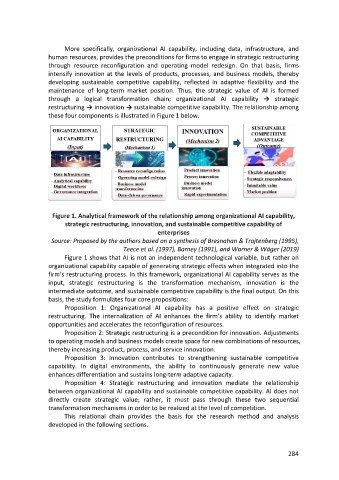
                  through a logical transformation chain: organizational AI capability → strategic
                  restructuring → innovation → sustainable competitive capability. The relationship among
                  these four components is illustrated in Figure 1 below.


                   Figure 1. Analytical framework of the relationship among organizational AI capability,
                        strategic restructuring, innovation, and sustainable competitive capability of
                                                        enterprises
                   Source: Proposed by the authors based on a synthesis of Bresnahan & Trajtenberg (1995),
                                            Teece et al. (1997), Barney (1991), and Warner & Wäger (2019)
                        Figure 1 shows that AI is not an independent technological variable, but rather an
                  organizational capability capable of generating strategic effects when integrated into the
                  firm’s restructuring process. In this framework, organizational AI capability serves as the
                  input, strategic restructuring is the transformation mechanism, innovation is the
                  intermediate outcome, and sustainable competitive capability is the final output. On this
                  basis, the study formulates four core propositions:
                        Proposition 1: Organizational AI capability has a positive effect on strategic
                  restructuring. The internalization of AI enhances the firm’s ability to identify market
                  opportunities and accelerates the reconfiguration of resources.
                        Proposition 2: Strategic restructuring is a precondition for innovation. Adjustments
                  to operating models and business models create space for new combinations of resources,
                  thereby increasing product, process, and service innovation.
                        Proposition 3: Innovation contributes to strengthening sustainable competitive
                  capability. In digital environments, the ability to continuously generate new value
                  enhances differentiation and sustains long-term adaptive capacity.
                        Proposition 4: Strategic restructuring and innovation mediate the relationship
                  between organizational AI capability and sustainable competitive capability. AI does not
                  directly create strategic value; rather, it must pass through these two sequential
                  transformation mechanisms in order to be realized at the level of competition.
                        This relational chain provides the basis for the research method and analysis
                  developed in the following sections.


                                                                                                      284

