


Page 118 - ISC PROCEEDINGS 21.4
P. 118
accessibility. The participation of SMEs in the AI transformation process is particularly
                  important. First, it helps broaden the growth base and limits productivity polarization
                  between large and small enterprises. Second, when SMEs adopt AI to optimize costs and
                  improve management, micro-level efficiency is translated into macro-level growth. Third,
                  the participation of SMEs shows that Singapore's policies supporting technology access
                  and computing infrastructure have yielded practical results. At the systemic level, the
                  diffusion of AI in SMEs increases the “digital depth” of the economy. This reinforces the
                  observation that Singapore's digital economy does not grow based on a few leading
                  enterprises but on a widespread network of businesses capable of applying technology.
                        3.2. Singapore’s NAIS 2.0 strategy: an ecosystem approach to ai governance and
                  growth
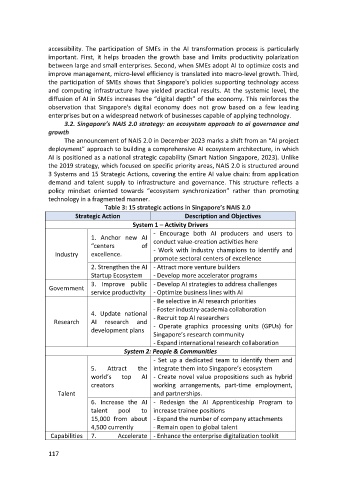
                        The announcement of NAIS 2.0 in December 2023 marks a shift from an “AI project
                  deployment” approach to building a comprehensive AI ecosystem architecture, in which
                  AI is positioned as a national strategic capability (Smart Nation Singapore, 2023). Unlike
                  the 2019 strategy, which focused on specific priority areas, NAIS 2.0 is structured around
                  3 Systems and 15 Strategic Actions, covering the entire AI value chain: from application
                  demand and talent supply to infrastructure and governance. This structure reflects a
                  policy mindset oriented towards “ecosystem synchronization” rather than promoting
                  technology in a fragmented manner.
                                      Table 3: 15 strategic actions in Singapore’s NAIS 2.0
                           Strategic Action                       Description and Objectives
                                                System 1 – Activity Drivers
                                                       - Encourage both AI producers and users to
                                 1. Anchor new AI      conduct value-creation activities here
                                 “centers          of
                    Industry     excellence.           - Work with industry champions to identify and
                                                       promote sectoral centers of excellence
                                 2. Strengthen the AI - Attract more venture builders
                                 Startup Ecosystem     - Develop more accelerator programs
                                 3. Improve public - Develop AI strategies to address challenges
                  Government
                                 service productivity  - Optimize business lines with AI
                                                       - Be selective in AI research priorities
                                                       - Foster industry-academia collaboration
                                 4. Update national
                    Research     AI   research   and   - Recruit top AI researchers
                                                       - Operate graphics processing units (GPUs) for
                                 development plans
                                                       Singapore’s research community
                                                       - Expand international research collaboration
                                             System 2: People & Communities
                                                       - Set up a dedicated team to identify them and
                                 5.    Attract   the integrate them into Singapore’s ecosystem
                                 world’s    top    AI - Create novel value propositions such as hybrid
                                 creators              working arrangements, part-time employment,
                     Talent                            and partnerships.
                                 6. Increase the AI - Redesign the AI Apprenticeship Program to
                                 talent    pool    to increase trainee positions
                                 15,000 from about - Expand the number of company attachments
                                 4,500 currently       - Remain open to global talent
                   Capabilities  7.       Accelerate - Enhance the enterprise digitalization toolkit


                  117

