


Page 117 - ISC PROCEEDINGS 21.4
P. 117
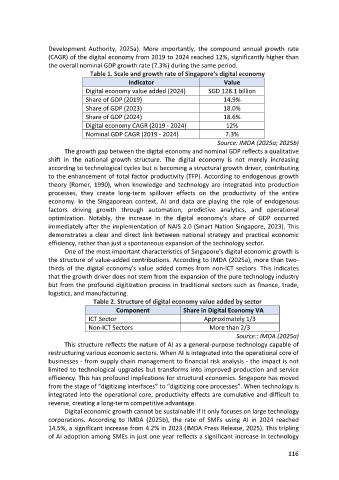
Development Authority, 2025a). More importantly, the compound annual growth rate
                  (CAGR) of the digital economy from 2019 to 2024 reached 12%, significantly higher than
                  the overall nominal GDP growth rate (7.3%) during the same period.
                                 Table 1. Scale and growth rate of Singapore’s digital economy
                                              Indicator                         Value
                               Digital economy value added (2024)         SGD 128.1 billion
                               Share of GDP (2019)                              14.9%
                               Share of GDP (2023)                              18.0%
                               Share of GDP (2024)                              18.6%
                               Digital economy CAGR (2019 - 2024)               12%
                               Nominal GDP CAGR (2019 - 2024)                   7.3%
                                                                             Source: IMDA (2025a; 2025b)
                        The growth gap between the digital economy and nominal GDP reflects a qualitative
                  shift in the national growth structure. The digital economy is not merely increasing
                  according to technological cycles but is becoming a structural growth driver, contributing
                  to the enhancement of total factor productivity (TFP). According to endogenous growth
                  theory (Romer, 1990), when knowledge and technology are integrated into production
                  processes, they create long-term spillover effects on the productivity of the entire
                  economy. In the Singaporean context, AI and data are playing the role of endogenous
                  factors driving growth through automation, predictive analytics, and operational
                  optimization. Notably, the increase in the digital economy's share of GDP occurred
                  immediately after the implementation of NAIS 2.0 (Smart Nation Singapore, 2023). This
                  demonstrates a clear and direct link between national strategy and practical economic
                  efficiency, rather than just a spontaneous expansion of the technology sector.
                        One of the most important characteristics of Singapore's digital economic growth is
                  the structure of value-added contributions. According to IMDA (2025a), more than two-
                  thirds of the digital economy's value added comes from non-ICT sectors. This indicates
                  that the growth driver does not stem from the expansion of the pure technology industry
                  but from the profound digitization process in traditional sectors such as finance, trade,
                  logistics, and manufacturing.
                                  Table 2. Structure of digital economy value added by sector
                                          Component              Share in Digital Economy VA
                                ICT Sector                               Approximately 1/3
                                Non-ICT Sectors                            More than 2/3
                                                                                    Source:: IMDA (2025a)
                        This structure reflects the nature of AI as a general-purpose technology capable of
                  restructuring various economic sectors. When AI is integrated into the operational core of
                  businesses - from supply chain management to financial risk analysis - the impact is not
                  limited to technological upgrades but transforms into improved production and service
                  efficiency. This has profound implications for structural economics. Singapore has moved
                  from the stage of “digitizing interfaces” to “digitizing core processes”. When technology is
                  integrated into the operational core, productivity effects are cumulative and difficult to
                  reverse, creating a long-term competitive advantage.
                        Digital economic growth cannot be sustainable if it only focuses on large technology
                  corporations. According to IMDA (2025b), the rate of SMEs using AI in 2024 reached
                  14.5%, a significant increase from 4.2% in 2023 (IMDA Press Release, 2025). This tripling
                  of AI adoption among SMEs in just one year reflects a significant increase in technology

                                                                                                      116

