


Page 102 - ISC PROCEEDINGS 21.4
P. 102
More recent theoretical work extends the Solow framework to incorporate AI as an
                  endogenous growth driver. Drawing on Romer's (1990) endogenous innovation model,
                  Ijmra (2026) argues that AI creates recursive feedback loops between technology,
                  knowledge, and output that redefine long-term growth trajectories, potentially
                  overcoming the diminishing returns of the classical Solow model. This AI-augmented
                  growth perspective suggests that economies investing early and systemically in AI
                  infrastructure may achieve compounded TFP advantages relative to later adopters, a first-
                  mover premium with direct implications for Vietnam's industrial strategy.
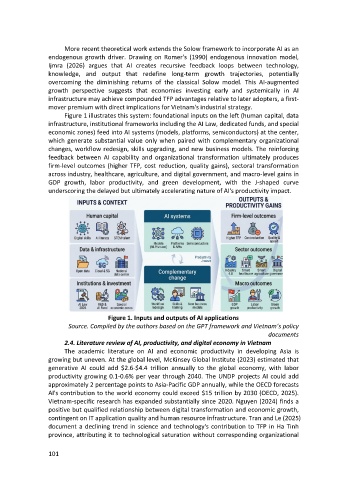
                        Figure 1 illustrates this system: foundational inputs on the left (human capital, data
                  infrastructure, institutional frameworks including the AI Law, dedicated funds, and special
                  economic zones) feed into AI systems (models, platforms, semiconductors) at the center,
                  which generate substantial value only when paired with complementary organizational
                  changes, workflow redesign, skills upgrading, and new business models. The reinforcing
                  feedback between AI capability and organizational transformation ultimately produces
                  firm-level outcomes (higher TFP, cost reduction, quality gains), sectoral transformation
                  across industry, healthcare, agriculture, and digital government, and macro-level gains in
                  GDP growth, labor productivity, and green development, with the J-shaped curve
                  underscoring the delayed but ultimately accelerating nature of AI's productivity impact.


                                       Figure 1. Inputs and outputs of AI applications
                         Source. Compiled by the authors based on the GPT framework and Vietnam’s policy
                                                                                               documents
                        2.4. Literature review of AI, productivity, and digital economy in Vietnam
                        The academic literature on AI and economic productivity in developing Asia is
                  growing but uneven. At the global level, McKinsey Global Institute (2023) estimated that
                  generative AI could add $2.6-$4.4 trillion annually to the global economy, with labor
                  productivity growing 0.1-0.6% per year through 2040. The UNDP projects AI could add
                  approximately 2 percentage points to Asia-Pacific GDP annually, while the OECD forecasts
                  AI's contribution to the world economy could exceed $15 trillion by 2030 (OECD, 2025).
                  Vietnam-specific research has expanded substantially since 2020. Nguyen (2024) finds a
                  positive but qualified relationship between digital transformation and economic growth,
                  contingent on IT application quality and human resource infrastructure. Tran and Le (2025)
                  document a declining trend in science and technology's contribution to TFP in Ha Tinh
                  province, attributing it to technological saturation without corresponding organizational


                  101

